Archive

August 30, 2026

Browsing

The post Wall Street Altcoin Picks: Charles Schwab Backs Ethereum, Solana, XRP and Hyperliquid appeared first on Coinpedia Fintech News

Charles Schwab’s director of global equity research, Adam Lynch, laid out the firm’s crypto allocation thinking in a recent appearance, distinguishing between five digital assets the firm views as serving fundamentally different roles in a portfolio: Bitcoin, Ethereum, Solana, XRP and Hyperliquid. Not All Crypto Is the Same Trade, Schwab Says Lynch described Bitcoin as …

The post Ripple News: XRP Surges 46% Versus BTC’s 21% As Expert Points to New Institutional Investor Class appeared first on Coinpedia Fintech News

XRP surged 46% in a week that saw Bitcoin gain roughly 21%, reigniting debate over whether the token is entering a genuinely different phase of its market cycle, one driven less by retail speculation and more by sophisticated capital seeking real-world utility. A Different Kind of Crypto Cycle Mickle, discussing the trend, said crypto has …

The post XRP News: CEO Garlinghouse Says Ripple Revenue Set To More Than Double appeared first on Coinpedia Fintech News

Ripple CEO Brad Garlinghouse said the company’s long-standing focus on connecting traditional finance with decentralized finance, once viewed skeptically within the crypto industry, has become one of Ripple’s core strengths as institutional adoption reshapes the sector. From Controversial Bet to Industry Consensus Garlinghouse said Ripple was “somewhat controversially” focused from early on on building a …

The post British Man Recovers 61 Bitcoin Lost for 12 Years, Now Worth $5M appeared first on Coinpedia Fintech News

A British Bitcoin investor has recovered 61 BTC that he lost access to after the collapse of an early crypto exchange in 2014. The coins are now worth about £3.3 million ($5 million), turning an original £1,500 investment into a multimillion-pound fortune after a 12-year fight. He says he plans to buy a bigger home …

The post Bitcoin News: Sberbank Plans BTC, ETH, and USDT-Backed Loans in Russia appeared first on Coinpedia Fintech News

Russia’s largest bank, Sberbank, is preparing to expand crypto-backed lending beyond Bitcoin, planning to accept Ethereum and Tether’s USDT as collateral for loans. The move comes as Russia prepares new crypto market rules, but Sberbank’s overall offering still depends on approval from the Bank of Russia. Sberbank Plans to Add ETH and USDT Sberbank Deputy …

Workday shares WDAY rose about 5% on Friday after the enterprise software company delivered stronger-than-expected second-quarter results, although mixed guidance and uncertainty over the pace of AI-driven growth prompted sharply different views among analysts.

The company reported revenue of $2.649 billion for the quarter ended July 31, up 12.8% from $2.348 billion a year earlier.

Adjusted diluted earnings per share climbed to $2.75 from $2.21.

The results exceeded Wall Street expectations for revenue of $2.64 billion and adjusted earnings of $2.61 per share.

Workday sees AI adoption gaining momentum

Workday’s results highlighted growing demand for its artificial intelligence products as the company seeks to turn AI adoption into higher-value customer relationships.

The company said AI accounted for more than 25% of new annual contract value during the quarter.

More than 5,500 customers were using at least one of Workday’s internally developed AI agents, representing an increase of more than 35% from the previous quarter.

AI annual recurring revenue also exceeded $600 million, reflecting rising interest in so-called agentic solutions.

However, the financial impact of that adoption is taking time to materialize.

Workday has been using promotional Flex Credits to encourage customers to experiment with its AI offerings, weighing on total subscription backlog growth, which rose 8% year over year.

Bank of America analysts said Workday’s AI strategy was “gaining traction but reacceleration is still elusive.”

“The company’s AI initiatives remain early-stage and may require time to drive meaningful financial impact. We lower our estimates to reflect a slower long-term growth trajectory and reiterate our Neutral rating and $205 PO,” they wrote.

Guidance leaves investors with mixed signals

Workday forecasts third-quarter subscription revenue of $2.515 billion, slightly above Wall Street’s $2.51 billion estimate.

For the full fiscal year, the company expects subscription revenue of between $9.940 billion and $9.950 billion, broadly matching analysts’ forecast of $9.95 billion.

While the outlook did not indicate a major deterioration in demand, analysts remained divided over whether Workday can accelerate growth as AI becomes a larger part of its product portfolio.

Freedom Broker downgraded the stock to Hold from Buy while raising its price target to $200 from $180.

The firm cited valuation concerns despite Workday’s strong operational performance.

It expects subscription revenue growth to slow to about 11% year over year during the second half of fiscal 2027 and fiscal 2028, partly because bookings are shifting toward Workday’s existing customer base.

The brokerage nevertheless raised its operating-margin forecast, citing the company’s progress on cost management.

Analysts remain split on Workday stock

Wall Street’s reaction to the earnings report has been unusually divided.

Capital One downgraded Workday to Equalweight from Overweight while maintaining a $219 price target, according to a note cited by TheFly.

Citi, meanwhile, raised its price target to $201 from $139 but maintained a Neutral rating.

The firm described the quarter as delivering a “more modest subscription revenue beat” and warned about the potential for another “guide down.”

Barclays was more positive, lifting its target to $224 from $200 and retaining an Overweight rating.

However, it expects a “muted” reaction, saying the “quarter itself was fine and suggests solid execution in a stable macro, but mixed guidance will raise questions.”

Morgan Stanley remained the most cautious among the major brokerages.

Analyst Adam Wood raised his target to $180 from $145 but retained an Underweight rating.

He said Workday’s in-line quarter and early fiscal 2028 guidance “set a growth floor and likely mark a clearing event,” but added that the firm continues to favor companies with more direct AI exposure.

Wells Fargo offered the most bullish assessment, raising its price target to $225 from $215 and maintaining an Overweight rating.

Analyst Michael Turrin said management’s surprise fiscal 2028 guidance helped anchor the firm’s model, although third-quarter cRPO guidance came in below expectations.

Wells Fargo continues to regard Workday as a high-quality asset with increasing terminal value.

AI opportunity faces a test of execution

The contrasting analyst views highlight the challenge facing Workday as it attempts to balance AI investment, customer adoption and growth expectations.

The company’s expanding AI revenue and rapid growth in customer adoption suggest its strategy is gaining traction. But analysts remain uncertain about how quickly those developments will translate into accelerated subscription growth.

For investors, the key question is whether Workday can convert its growing AI footprint into stronger bookings and recurring revenue without relying heavily on promotional incentives.

Friday’s share-price jump suggests investors initially focused on the earnings beat and improving AI adoption. The divided analyst outlook, however, indicates that the market remains cautious about whether Workday’s AI opportunity can produce a meaningful reacceleration in growth.

The post Workday stock jumps 5% after earnings beat, but analysts split on AI growth outlook appeared first on Invezz

The US stock market ended lower on Friday as investors assessed Federal Reserve Chair Kevin Warsh’s warning that recent inflation data had not shown enough improvement to alter the underlying trend.

The remarks increased expectations for a potential interest rate hike in September.

The S&P 500 fell 0.26% to 7,711.05, while the Nasdaq Composite dropped 0.53% to 26,400.56. The Dow Jones Industrial Average slipped 0.02% to 53,558.38.

Despite Friday’s declines, the Dow gained 0.5% for the week. The S&P 500 and Nasdaq fell 0.5% and 0.9%, respectively, over the same period.

Warsh comments lift rate hike expectations

Speaking at the Federal Reserve’s annual symposium in Jackson Hole, Wyoming, Warsh said recent PCE and CPI readings, while better than expected, did not indicate that underlying inflation trends had “meaningfully improved.”

He said the Federal Reserve needed to be confident that underlying inflation was moving toward its 2% target “clearly and at sufficient speed.” Otherwise, he said, the central bank still had work to do.

The comments prompted traders to increase their bets on a September rate hike.

According to CME Group’s FedWatch tool, the probability of a rate increase rose to around 57% on Friday from 35.4% a day earlier.

Treasury yields at the short end of the curve moved higher following the speech, while longer-term yields were roughly flat.

Mark Hackett, chief market strategist at Nationwide, said Warsh was reiterating the Fed’s hawkish stance rather than signaling an incremental change.

Bill Birmingham, managing director at REX Financial, similarly described the speech as a strong message about the Fed’s approach to inflation and monetary policy.

Chip stocks pull back

Technology stocks came under pressure, with semiconductor shares weighing on the Nasdaq. Nvidia declined, while Marvell Technology tumbled about 10% after its current-quarter non-GAAP gross margin guidance disappointed investors.

Marvell’s shares fell despite the company raising its 2027 revenue forecast. Investors remained concerned about the timing of revenue from its AI chip agreement with Alphabet.

The move followed a strong previous session for chip stocks, which had rallied after Nvidia issued a forecast signaling continued strength in AI-related demand.

Most megacap technology stocks were higher, however.

Alphabet gained, providing the biggest boost to the S&P 500’s communication services sector, while Apple also advanced. Salesforce extended its previous-session gains, supporting the Dow.

Gap jumps while Ulta and PayPal fall

Outside technology, Gap shares climbed after the retailer named industry veteran Michael Francis as the new chief executive of Old Navy and raised its annual profit forecast. The company’s shares gained despite a mixed quarterly report.

PayPal declined after Bloomberg News reported that a consortium involving Advent and Stripe had abandoned its pursuit of the payments company.

Ulta Beauty also fell after comparable sales growth slowed in the second quarter.

Investors additionally assessed consumer sentiment data. The final reading of the University of Michigan’s consumer sentiment survey came in at 51.7, slightly above economists’ estimate of 51.

With markets now closely split between a September rate hike and a hold, investors are likely to focus on upcoming inflation and employment data for further clues on the Federal Reserve’s next move.

The post Dow holds weekly gain as Warsh inflation warning lifts rate hike bets appeared first on Invezz

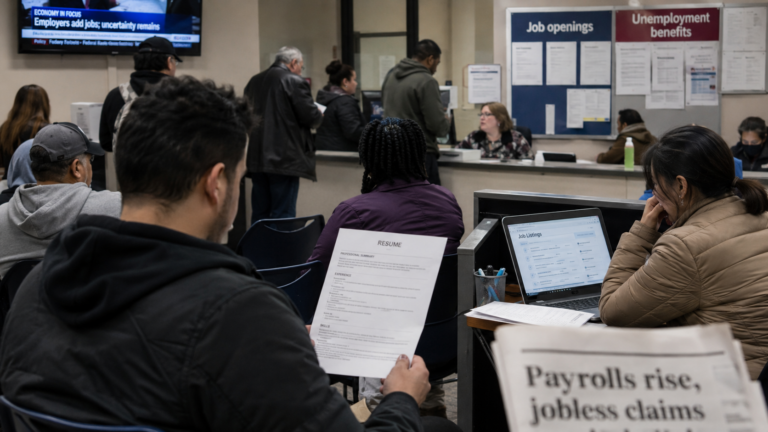
Every week, people are handed another piece of US jobs data and told it matters for markets.

News platforms, including Invezz, report initial and continuing jobless claims every week, before attention shifts through the month to ADP employment, JOLTS and the closely watched nonfarmpayrolls report.

For anyone who does not spend their day watching economic calendars, it can feel like several versions of the same number.

They are not.

Each report looks at a different part of the labour market. Some tell us whether people are losing jobs.

Others show whether businesses are hiring, how long unemployed workers are struggling to find work, or whether employees feel confident enough to quit.

That distinction matters even if you have no intention of trading the next jobs report.

Employment drives household income and consumer spending. Wage growth can influence inflation. Both feed into Federal Reserve decisions, which in turn affect Treasury yields, the dollar, equities and eventually borrowing costs faced by households and businesses.

The differences are especially relevant now.

Initial jobless claims fell to 203,000 in the week ended August 22, keeping layoffs historically low, while continuing claims stood at 1.778 million in the prior week.

Yet July’s official employment report showed nonfarm payrolls falling by 23,000, while the unemployment rate edged down to 4.1%.

Meanwhile, ADP estimated that private employers added 44,000 jobs in July.

Confusing? Only if we expect all of those numbers to answer the same question.

Claims show whether jobs are disappearing, not whether hiring is healthy

Start with the data investors see most often.

Initial jobless claims are released weekly and count new applications for unemployment benefits. In simple terms, they are one of the quickest ways of spotting a rise in layoffs.

If claims suddenly move sharply higher and remain elevated, it can signal that companies are cutting workers more aggressively.

Low claims tell us something useful too: employers are largely holding on to the people they already have.

When claims fell to 187,000 in July, their lowest level since 1969, Oxford Economics senior US economist Matthew Martin said the extremely low level highlighted the labour market’s “low layoff rate.”

But there is an obvious limitation.

A company deciding not to fire you tells us very little about whether another company wants to hire you.

That is where continuing claims become useful. These measure people who have already made an initial claim and remain on unemployment benefits in subsequent weeks.

They can therefore provide clues about how difficult it is for someone who loses a job to get back into work.

Even here, the headline number needs care.

Research published by the Federal Reserve Bank of Richmond in July found that continuing claims had been declining largely because fewer people were entering unemployment, not because existing claimants were leaving unemployment more quickly.

The weekly exit rate from unemployment insurance was around 11.7% in the first half of 2026, compared with 15.2% in 2022, according to the research. That gives us an important distinction:

Initial claims ask: are more people losing their jobs?

Continuing claims ask: what is happening to those already unemployed?

A labour market can look healthy on the first measure and considerably less comfortable on the second.

Payrolls, ADP and JOLTS look at different stages of the jobs cycle

Then comes the monthly barrage.

Nonfarm payrolls, usually abbreviated to NFP, form part of the Bureau of Labor Statistics’ monthly Employment Situation report and are generally the headline number Wall Street watches most closely.

But even the jobs report itself contains two major surveys.

The establishment survey measures payroll employment, hours and earnings at businesses and government agencies. It produces the nonfarm payrolls number.

The separate household survey measures whether people are employed, unemployed or outside the labour force. That is where the unemployment rate and labour-force participation rate come from.

The two can move differently because they use different samples and definitions. BLS itself says both are needed to obtain a complete picture of the labour market.

This is why a fall in payrolls does not automatically require the unemployment rate to rise in the same month.

And it is why staring only at the big payroll number can be misleading.

Following July’s 23,000 payroll decline, LinkedIn’s head of economics for the Americas, Kory Kantenga, told Yahoo Finance that investors should “scroll past that big headline number,” pointing to unusual seasonal effects in local government education employment.

ADP adds another layer.

Its National Employment Report uses anonymised payroll records covering more than 26 million US employees to estimate changes in private-sector employment.

Crucially, ADP explicitly says the report is an independent measure and is not intended to forecast the BLS nonfarm payroll report.

That point is often lost.

If ADP says private employment rose and NFP subsequently disappoints, it does not necessarily mean ADP “got payrolls wrong.”

The two reports use different datasets and methodologies, while official NFP also includes government employment.

ADP can also provide information that the headline hiring number misses. In July, for example, it reported 44,000 additional private-sector jobs but also found annual pay growth for job-changers accelerating to 7%.

“Job-changers are highly sensitive to real-time economic conditions,” ADP chief economist Nela Richardson said.

Then there is JOLTS: the Job Openings and Labor Turnover Survey.

Instead of asking only how many people are employed, JOLTS looks inside the machinery of the jobs market: vacancies, hires, quits, layoffs and other separations.

June data showed about 7.4 million openings, 5.3 million hires and 3.2 million quits.

Openings provide a measure of employer demand. Hires show whether those intentions are turning into actual jobs.

Quits can provide clues about worker confidence, since people are usually more willing to leave voluntarily when they believe another opportunity is available.

Again, one headline should not dominate the interpretation.

ZipRecruiter labour economist Nicole Bachaud told HR Brew that she would not focus “too heavily on a one-month drop in openings” when other parts of the data were showing relative stability.

Why investors should care when the numbers disagree

The easiest mistake is to decide that one jobs report is right and another is wrong. Often, they are simply describing different stages of the same labour market.

Imagine companies stop advertising as many vacancies but are reluctant to fire existing staff.

JOLTS openings could weaken while initial claims remain low.

Hiring could then slow further, leaving people who do lose their jobs searching for longer. Continuing claims could rise even though layoffs remain subdued.

Payroll growth might not turn negative until later.

None of those signals contradicts the others.

Together, they describe a labour market moving from strong hiring towards what economists often call a low-hire, low-fire environment.

Understanding that sequence is crucial for markets because the Fed has both inflation and employment considerations when setting monetary policy.

A surprisingly strong jobs report, particularly when accompanied by rapid wage growth, can strengthen the argument for tighter monetary policy if investors think labour demand could keep inflation elevated.

Weak employment data can pull the other way by increasing concern about economic growth and the employment side of the Fed’s mandate.

That reassessment can quickly move interest-rate expectations, Treasury yields, the dollar and equity valuations.

After July’s payroll disappointment, Charlie Ripley, senior investment strategist at Allianz Investment Management, told Fortune that the report put the “spotlight back on the employment side of the Fed’s mandate”.

The implications are less abstract for households.

Initial claims can tell you whether job security is deteriorating. Continuing claims can offer clues about how hard finding another role has become.

JOLTS can show whether employers still have an appetite to hire. Wage data tells you how much bargaining power workers retain.

And payrolls pull much of that information together into the broadest monthly snapshot markets receive.

So, if you only have a few minutes when the next round of jobs data lands, do not ask which number is the “real” one.

Ask what question each number is trying to answer.

The post Invezz Explains: why you should closely watch payrolls, claims, ADP and JOLTS data appeared first on Invezz

From a strategy being dubbed “balance sheet as a service” to Nvidia itself being described as the central bank of artificial intelligence, the chipmaker’s growing role in financing the AI ecosystem is attracting more attention from investors.

Nvidia has transformed itself from a semiconductor company into one of the most important financial backers of the AI infrastructure boom.

Its public and private equity holdings reached $95.6 billion at the end of July, up from less than $100 million in early 2020, while the company has said its broader equity investments now total roughly $99 billion.

Its portfolio includes stakes in Intel, CoreWeave, Coherent, Nokia, Synopsys and Nebius, among others.

At the same time, Nvidia is increasingly providing guarantees, backstops and other forms of financial support to companies building the data centers required to run AI models.

That strategy could help accelerate infrastructure spending and secure future demand for Nvidia’s chips.

But it also raises a more uncomfortable question for investors: what happens if AI infrastructure supply grows faster than demand?

Nvidia is becoming more than a chipmaker

Nvidia’s latest financing initiatives demonstrate how dramatically its role in the AI industry has changed.

The company agreed to buy up to an estimated 500 megawatts of unused data-center capacity from CoreWeave for $6.3 billion.

If CoreWeave cannot rent out the capacity to other customers, Nvidia effectively becomes the customer of last resort.

Nvidia has also provided significant financial support for data-center developments, including a planned compute campus in Ohio where OpenAI is expected to be a tenant.

The company ultimately agreed to provide a guarantee of up to $105 billion to help OpenAI lease the sprawling facility, according to reports.

That figure was substantially lower than the $250 billion commitment that had previously been discussed following investor concerns over Nvidia’s exposure.

Nvidia has separately contributed $30 billion to the record-breaking funding round OpenAI completed in March.

The scale of those transactions has led some investors to question whether Nvidia is simply financing the expansion of an industry that then uses the resulting capital to purchase Nvidia products.

That is the essence of the circular-financing concern.

In a typical circular arrangement, a company provides financial support to customers that subsequently use some of that support to buy its products.

Critics argue that such structures can make demand appear stronger than it would be without the financing.

The comparison has prompted memories of financing practices during the dot-com bubble, although the underlying economics of today’s AI infrastructure market are very different.

Nvidia CEO Jensen Huang has rejected the idea that the company is using investments to artificially inflate its growth.

“I think the only regret that I have is that I didn’t invest more and sooner,” Huang said of Nvidia’s investments in AI laboratories.

Morgan Stanley sees a $200 billion exposure

Morgan Stanley has taken a closer look at the potential risks.

The bank recently initiated credit coverage of Nvidia with a neutral view, arguing that the company’s exceptional growth is turning balance-sheet strength into a strategic AI financing tool while introducing new risks.

“We initiate credit coverage of Nvidia with a neutral view as exceptional growth turns balance sheet strength into a strategic AI financing tool – and introduces new risks,” Morgan Stanley analyst Lindsay Tyler wrote.

The analysts estimate that Nvidia could have total credit exposure of roughly $200 billion by the end of 2028.

Importantly, most of that figure would not represent conventional borrowing.

Morgan Stanley estimates that around $170 billion could come from guarantees and backstops that currently sit off Nvidia’s balance sheet but could become financial obligations if conditions deteriorate.

The bank has dubbed the strategy “balance-sheet-as-a-service.”

The central question is how investors should treat Nvidia’s support packages, lease commitments and guarantees.

While they are not necessarily debt in the traditional sense, they can create financial obligations that become significant if the projects or customers Nvidia supports run into trouble.

That distinction matters because Nvidia’s enormous profitability and cash generation give it considerable financial flexibility today.

The concern is less about whether Nvidia can afford these commitments under normal circumstances and more about whether multiple guarantees could be triggered simultaneously during an AI downturn.

Nvidia wants to unlock $500 billion of AI investment

That question has gained urgency following Nvidia’s announcement of “repeatable financing platform” agreements with Apollo, BlackRock, Blackstone, Brookfield, Goldman Sachs and KKR, aimed at mobilizing more than $500 billion in third-party capital for AI infrastructure projects.

The goal is to bring institutional capital into an industry where enormous upfront investments are required to construct data centers, purchase GPUs and develop the supporting infrastructure.

Nvidia has emphasized that it is not putting up the entire $500 billion.

Instead, the company may provide residual-value support for up to 25% of an individual opportunity, depending on the project.

In practical terms, that means Nvidia could absorb a defined portion of the loss if the GPUs or other assets backing a project ultimately prove to be worth less than expected.

At 25% of $500 billion, the theoretical maximum would amount to $125 billion.

That does not mean Nvidia has committed to $125 billion in cash payments.

The actual exposure would depend on the projects financed, the amount drawn, asset values, and the circumstances under which guarantees are triggered.

Still, the size of the potential obligation explains why investors are paying closer attention.

Nvidia CEO Jensen Huang has argued that bringing major financial institutions into the process represents “the beginning of an open capital market for AI infrastructure.”

The approach could also help address concerns about circular financing by shifting more of the funding burden to outside investors rather than Nvidia itself.

The real risk comes if AI demand weakens

The more difficult issue is what happens if the assumptions underpinning the AI buildout prove too optimistic.

Morgan Stanley has used a $35 billion chip-lease agreement involving Broadcom and Google-designed tensor processing units for Anthropic as one template for understanding how these structures could work.

Under similar arrangements, chips can be sold to private credit vehicles funded by institutional investors, with the manufacturer providing some degree of support.

Morgan Stanley estimates that if Nvidia signed 15 comparable financing arrangements by the end of 2028, its tail-risk exposure could peak at nearly $90 billion shortly afterward, taking into account drawdowns and amortization.

The bank also noted that rating agencies have shown a preference for treating roughly $125 billion of Nvidia’s financing structures as debt-like.

The more opaque area is Nvidia’s individual arrangements with customers and neocloud companies.

Nvidia recently described a “revenue-sharing and credit-support model” designed to expand access to its chips beyond the largest hyperscalers.

One possible structure would involve Nvidia guaranteeing a minimum price for GPU capacity rented by neocloud providers, while taking a share of revenue above that threshold in addition to its traditional chip sales.

The arrangement could help smaller AI infrastructure providers secure financing and give Nvidia another route to expand its addressable market.

But it also creates a common point of vulnerability.

If AI demand weakens, GPU rental prices could fall, data-center capacity could remain unused, and the value of older GPUs could decline.

Those are precisely the circumstances in which Nvidia’s guarantees could become more expensive.

Nvidia is effectively insuring its own market

Vested Finance has argued that the headline numbers need to be put into perspective.

Nvidia’s enormous revenue and cash-generation capacity mean that $200 billion of potential exposure does not automatically translate into a balance-sheet crisis.

Morgan Stanley’s calculations put gross leverage at around 0.4 times currently, rising to roughly 0.7 times if growth flattens in 2028.

The company could therefore absorb a considerable amount of additional financial obligations before approaching the type of leverage levels that would normally trigger serious credit concerns.

But the timing of potential losses matters.

“The real issue is when the guarantees get called,” Vested Finance said.

Residual-value support would become relevant if used GPUs were worth less than expected.

Revenue guarantees could become costly if neoclouds failed to rent their capacity at profitable rates.

CoreWeave-style backstops could be triggered if data-center capacity went unused.

All three scenarios ultimately point to the same underlying problem: AI compute demand falling short of supply.

That creates an unusual relationship between Nvidia’s financial commitments and its operating business.

If AI demand falls sharply enough to trigger guarantees, Nvidia could simultaneously face weaker orders for its own chips.

In other words, the company could be required to provide financial support to an ecosystem at precisely the time when its own revenue and cash flow are coming under pressure.

Vested Finance described Nvidia as effectively selling put options on its own end market, comparing it to an insurer writing earthquake policies on buildings located in its own city.

The analogy captures the central concern.

Nvidia benefits enormously when AI infrastructure demand remains strong, but its financial exposure could rise when that same demand begins to weaken.

GPU depreciation adds another layer of uncertainty

The financing strategy is also closely connected to a long-running debate over the useful life of AI accelerators.

Compute operators have argued that GPUs can remain economically useful well beyond the six-year depreciation schedules commonly used for accounting purposes.

Skeptics believe the rapid pace of technological advancement means some hardware could become economically obsolete within three to five years.

The difference matters enormously for Nvidia’s financing arrangements.

If GPUs retain their value for a long time, residual-value guarantees may never be called. Nvidia could then help facilitate hundreds of billions of dollars of infrastructure investment while taking relatively limited losses.

If GPU values fall rapidly, however, the company could be forced to absorb the difference between expected and actual asset values.

And those losses could emerge during an industry downturn, when Nvidia’s own sales are under pressure.

Nvidia’s commitments are rising rapidly

The company’s latest disclosures illustrate the scale of the expansion.

Nvidia reported supply and capacity commitments of $279 billion, up sharply from $119 billion in the previous quarter, primarily because of commitments to secure memory.

Total future commitments stood at approximately $366 billion.

The company also reported another $56 billion of AI-cloud and third-party lease commitments, while maximum gross guarantees reached $108.5 billion.

Up to $105 billion of that amount is connected to the OpenAI and SB Energy data-center development in Ohio.

Separately, Nvidia’s partnerships with major financial institutions are intended to mobilize more than $500 billion of third-party capital for AI infrastructure.

The commitments are not necessarily evidence of financial weakness.

In fact, they could strengthen Nvidia’s competitive position by helping customers obtain scarce infrastructure and ensuring that its chips are deployed at scale.

But the complexity of Nvidia’s financial relationships with its customers is increasing.

“This does not automatically make the revenue circular. It does mean Nvidia is increasingly helping to create and finance the ecosystem into which it sells,” said Charu Chanana of Saxo.

Investors now have more than GPU sales to watch

For years, the primary question for Nvidia investors was straightforward: how many GPUs can the company sell, and at what margins?

That equation is becoming more complicated.

Nvidia’s equity investments, guarantees, leases, revenue-sharing agreements and infrastructure commitments are increasingly intertwined with the growth of the AI market.

“These arrangements can help Nvidia secure scarce supply, accelerate customer deployments and expand its addressable market,” Chanana said.

“But they also make the company’s risk profile more complex. Investors increasingly need to consider customer credit quality, leases, guarantees, revenue-sharing agreements and Nvidia’s equity investments—not just GPU shipments,” said Chanana.

The company’s financial position remains strong, and its financing strategy could ultimately prove highly profitable if AI demand continues to expand at the pace Nvidia expects.

The strategy could also help solve one of the industry’s biggest challenges: finding enough capital to build the data centers needed to support increasingly powerful AI models.

But the very success of the model could make the risks harder to see during the boom.

As long as AI demand continues to exceed supply, Nvidia’s guarantees are unlikely to look particularly threatening. GPU values remain high, data centers stay occupied, and customers continue ordering chips.

The test will come if that equation changes.

Nvidia has spent years building the infrastructure, software and semiconductor ecosystem around the AI boom. It is now increasingly helping finance it as well.

That could make the company an even more powerful beneficiary of continued AI expansion. But it also means that, should the AI cycle eventually turn, Nvidia may have more than its chip business at stake.

The post Nvidia is using its balance sheet to fuel the AI boom. Is it a double-edged sword? appeared first on Invezz


As governments and regulators around the world intensify scrutiny of social media’s impact on children, Meta’s landmark US settlement marks a major shift in how technology companies may be held accountable for the way their platforms are designed and used.

Meta has agreed to overhaul parts of Instagram and Facebook in the United States and pay up to $18 billion to settle a landmark lawsuit brought by dozens of states that accused the social media giant of deliberately designing its platforms to addict children and exposing young users to serious mental health harms.

The settlement, reached Wednesday, brings a major California trial to an end and marks the first time in the United States that Meta has been forced to change key features of the everyday social media experience as part of a legal agreement.

The deal requires Meta to introduce a series of safeguards for users under 18, including default limits on daily usage, restrictions on nighttime access and changes to how content and notifications are presented to teenagers.

Officials described it as the biggest state consumer-protection settlement outside the tobacco settlements of the 1990s.

Meta faces its biggest US settlement yet

The size of the agreement underscores the growing legal pressure facing Meta and the wider social media industry over the impact of online platforms on children.

Meta’s payment is more than 12 times the previous highest settlement recorded over the past four years.

That benchmark was set by Meta itself in 2024, when it agreed to pay $1.4 billion to settle a separate case.

The latest agreement also represents the largest settlement ever reached with a single company through the New York attorney general’s office.

The previous record was a $7.4 billion settlement reached in 2022 with Purdue Pharma and the Sackler family over the opioid crisis.

The lawsuit alleged that Meta intentionally incorporated addictive features into Instagram and other products while failing to adequately warn the public about potential risks to young users.

The states argued that the company knew its products could contribute to harmful experiences among children but continued to prioritize engagement.

The settlement does not simply impose a financial penalty.

It requires changes to the products themselves, potentially establishing a new template for how technology companies can be held responsible for the design of services used by children.

Measures put in place for teenagers’ use

Under the agreement, Meta will automatically apply several protections to users under 18 on Instagram and Facebook in the US.

The most significant change is a default two-hour daily usage limit. Teenagers will be able to disable the restriction only with permission from a parent.

Meta will also introduce a default Night Mode that blocks access to its applications between midnight and 6 a.m.

During those hours, teenagers will not be able to post or view content through Feed, Stories, Explore or Reels.

The company is also introducing a School Mode feature that will mute notifications by default between 8 a.m. and 3 p.m.

Certain communications will remain accessible. Direct messages and alerts relating to account security or safety will not be blocked under the school-time restrictions.

The changes extend beyond limits on how long teenagers can use the platforms.

Meta said it would also introduce greater controls over algorithmic feeds and autoplay, while users will have options to hide the number of likes and reactions appearing on posts.

The company will also disable cosmetic surgery and extreme makeup filters for teenage users.

Taken together, the measures represent a substantial intervention in the design of Instagram and Facebook, two products whose growth has historically relied heavily on maximizing engagement and keeping users active on their platforms.

How the settlement could have global consequences

Although the agreement applies to Meta’s US operations, its significance is unlikely to stop at the country’s borders.

Governments around the world are already looking for ways to reduce children’s exposure to harmful online content and limit the amount of time young people spend on social media.

Australia has taken the most aggressive approach so far.

It became the first country to introduce a nationwide ban on social media access for children under 16 late last year.

Australian Communications Minister Anika Wells said Meta’s latest changes demonstrated that social media companies already have the ability to protect children from potentially addictive features.

Australian Communications ​Minister Anika Wells said in an email to Reuters that social media companies “have the tools at their disposal to protect young people from their addictive features but have chosen not ​to use them”.

Australian officials said Meta’s decision to restrict teenage use of its platforms in the US showed that companies could implement stronger safeguards for young people online.

In the Philippines, an official told Reuters that Meta had also pledged to strengthen protections for young users there.

South Korea’s media regulator went further, arguing that some of Meta’s new measures should be extended to young users worldwide rather than being limited to individual markets, Reuters reported.

The international response could add pressure on Meta to standardize some of its protections across countries, particularly as governments increasingly coordinate their approaches to children’s online safety.

Social media companies face a growing legal backlash

The Meta settlement comes during a particularly difficult year for social media companies.

In the spring, Meta lost two high-profile court cases involving allegations that its products, including Instagram, harmed young users.

Other major platforms, including YouTube, TikTok and Snapchat, have also faced similar litigation, with companies settling some cases while thousands of lawsuits remain pending.

TikTok this week reached a separate $400 million settlement with the US Justice Department over allegations that it illegally collected children’s data.

At the same time, US states have been passing their own restrictions on children’s social media use.

The regulatory pressure is no longer confined to the US.

Britain, Canada, Denmark, Indonesia and New Zealand have indicated that they intend to follow Australia’s lead on restricting social media access for younger users.

France has also pursued restrictions, although a law that would have banned children under 15 from social media was blocked this month on constitutional grounds.

The growing patchwork of regulations could eventually make it more difficult for social media companies to maintain different safety standards in different countries.

Evidence from lawsuits could fuel further regulation

The significance of Meta’s settlement may extend beyond the specific restrictions imposed on Instagram and Facebook.

Legal proceedings against Meta have brought internal documents and communications involving employees and executives into the public domain.

Those materials could become valuable to researchers, lawmakers and regulators examining how technology companies design products and assess their potential harms.

“There’s clearly an enormous momentum shift here in the United States and globally in the public’s assessment of social media platforms and the broader tech industry,” said Jim Steyer, CEO of Common Sense Media, a nonprofit research and advocacy organization, in an NPR report.

Isabel Sunderland, policy lead for technology reform at Issue One, a bipartisan nonprofit focused on political reform, said the settlement could have a broader impact on lawsuits, legislation and regulation.

She pointed to internal documents and communications that have emerged during the federal trial in Oakland, as well as earlier trials in California and New Mexico state courts this year.

“They’re also opening up huge troves, thousands of documents of discovery that is hugely important for researchers, for lawmakers to be able to write better policy, for the public to understand what their relationship to technology looks like, and how technology companies are designing their products,” she said in the NPR report.

That evidence could prove particularly important as lawmakers attempt to determine whether existing consumer-protection and privacy laws are sufficient to address the risks associated with algorithm-driven platforms.

“Legally, the settlement does not create a precedent in the way a ​court decision would. But it will matter in practice. Other states and plaintiffs now have another indication that these cases can survive substantial legal challenges, reach trial, and create very significant financial exposure for Meta,” said Daryl Lim, a professor at Penn State Dickinson Law.

Whistleblower testimony puts Meta’s internal practices under scrutiny

One of the most significant pieces of evidence to emerge during the federal trial came from former Meta engineer and whistleblower Arturo Béjar.

Béjar testified that he had been involved in internal studies examining how frequently users encountered harmful content, including bullying, self-harm and violence.

According to his testimony, Meta did not publicly release the results of those studies. Instead, the company published other metrics focused on violations of its content policies.

Béjar argued that those measurements did not capture the extent of harm experienced by users and created “a false impression of safety.”

The dispute highlights one of the central issues at the heart of the litigation: whether technology companies’ public measurements adequately reflect the risks users face on their platforms.

Sunderland said the evidence surrounding how companies make decisions could prove particularly valuable to lawmakers.

“The decision-making process of the companies has been a huge piece of evidence that we’ve pulled out from these trials,” Sunderland said.

She argued that the information could help lawmakers draft new legislation and give regulators greater insight when responding to technology companies’ challenges to laws after they are enacted.

A new test for Meta and the wider industry

For Meta, the settlement removes the immediate threat of a major trial while imposing significant changes on two of its most important platforms.

The financial cost is substantial, but the longer-term implications could be even more consequential.

The company will have to demonstrate that its new restrictions can be implemented effectively without undermining the broader user experience. It will also face questions over whether similar protections should eventually be extended beyond the US.

For the rest of the technology industry, meanwhile, the settlement offers a warning that regulators and courts are increasingly looking beyond content moderation and data privacy and examining the design of the products themselves.

The case could also encourage other states and countries to pursue similar restrictions and settlements.

Meta’s agreement therefore represents more than a costly resolution to one lawsuit. It signals a broader shift in how governments view social media companies and their responsibilities toward younger users.

As regulators gain access to more internal evidence and lawmakers face growing public pressure to act, the industry’s long-standing emphasis on engagement could face increasingly stringent limits.

The settlement may ultimately prove to be a turning point — not only for Meta, but for the way governments regulate social media platforms built to keep users coming back.

The post How Meta’s $18B teen safety settlement could reshape social media regulation appeared first on Invezz