Archive

August 15, 2026

Browsing

The post XRP Price News Today: XRP Falls Below $1 as Experts Recall Bitcoin’s 470 ‘Death’ Calls appeared first on Coinpedia Fintech News

XRP fell below the $1 mark this week, touching as low as $0.99, as a broader crypto market selloff dragged prices lower across the board. The move triggered a familiar wave of bearish commentary online, with some traders declaring the token, and crypto broadly, on the way out. But not everyone in the market is …

The post Oil to Bitcoin: Norway and UAE Boost Wealth Funds via MSTR and BlackRock appeared first on Coinpedia Fintech News

Global oil giants Norway (the 12th-largest global oil producer) and the United Arab Emirates (UAE; the 9th-largest global oil producer) are increasingly exposing their sovereign wealth funds (SWFs) to Bitcoin (BTC). Norway state-owned fund invests in Bitcoin A recent disclosure shows that Norway’s Government Pension Fund Global, also known as the “Oil Fund,” increased its …

The post Chainlink Breaks Above $9 — Can Whale Accumulation Drive LINK Price Above $12? appeared first on Coinpedia Fintech News

The Chainlink (LINK) price has finally broken out of the consolidation structure that had been developing since June. After recovering from lows near $7, LINK pushed above the $9.04 resistance and is now trading around $9.45, marking a clear shift in its short-term technical structure. The breakout also comes as on-chain activity among large holders …

The post Everyone Is Bearish on XRP—But On-Chain Activity Tells a Different Story: What’s Next for Price? appeared first on Coinpedia Fintech News

XRP price has been facing increasing selling pressure, with market sentiment turning noticeably bearish in recent weeks. The shift in sentiment comes as XRP continues to struggle around the $1 mark, keeping traders cautious about what could come next. However, not all market signals are pointing in the same direction. While the broader mood around …

The post Uniswap Faces a Critical Test at $3.20 After Sharp Rejection—Is UNI Heading to $3 or Loading Up for a $4 Rebound? appeared first on Coinpedia Fintech News

Uniswap price has come under renewed selling pressure after facing a sharp rejection from the $4.40–$4.50 region, pushing the token back toward a crucial support zone around $3.20. The latest decline has brought UNI to an important decision point, where buyers will need to defend this level to prevent further downside. With the price now …

Fenway Sports Group (FSG) has agreed to sell a minority stake in Liverpool FC to 1892 Holdings, a consortium led by investor Amit Bhatia and backed by Amazon Executive Chairman Jeff Bezos, the Mittal Family Trusts, EE Capital and K5 Sports.

The deal values the Premier League club at around £5.5 billion, according to reports, while allowing FSG to retain majority ownership and operational control.

The transaction, which remains subject to regulatory approval, is designed to support Liverpool’s long-term growth by bringing together investors from technology, finance and global business without altering the club’s day-to-day management.

FSG retains control as new investors join Liverpool

FSG said the agreement reflects its long-term approach to ownership and its belief that the consortium shares the club’s vision for sustainable growth.

“Liverpool has always been built by thinking beyond one season and making decisions with the club’s long-term interests in mind,” FSG President Mike Gordon said in a statement.

Gordon added that the ownership group concluded Amit Bhatia and his partners shared “our long-term philosophy and appreciation for what makes Liverpool special,” saying their experience would complement the club’s existing foundation.

Reuters, citing a source familiar with the matter, reported the consortium is acquiring roughly a one-third stake in Liverpool in a deal worth more than £1.5 billion.

The Guardian reported the investment values the club at approximately £5.5 billion.

FSG acquired Liverpool in 2010 for £300 million after the troubled ownership of Tom Hicks and George Gillett.

The group said the latest transaction is not part of an exit strategy and does not obligate either side to increase or reduce their ownership in the future, although the consortium has options to acquire a larger stake if FSG eventually decides to sell.

Bezos-backed consortium expands Liverpool board

The investor group operates under the name 1892 Holdings, referencing Liverpool’s founding year, and is led by former Queens Park Rangers chairman Amit Bhatia.

Under the agreement, Bhatia will become Liverpool’s vice chairman and join an expanded board alongside Elaine Saverin of EE Capital and Bryan Baum of K5 Sports. Jeff Bezos, despite being the lead investor in K5 Sports, will not hold a seat on Liverpool’s board.

“We are making this investment because we believe deeply in Liverpool and its leadership,” Bhatia said, adding that becoming a partner in a club of Liverpool’s stature is “a huge privilege.”

The consortium also includes backing from the Mittal Family Trusts and EE Capital, the family office of Elaine and Eduardo Saverin.

Investment targets long-term commercial growth

FSG said the investment is intended to strengthen Liverpool’s long-term commercial opportunities rather than fund immediate changes to football operations.

According to the club, the transaction will have no impact on Liverpool’s transfer budget, recruitment strategy or day-to-day leadership. Regulatory approval could take up to 90 days.

The ownership group believes the consortium’s business expertise and global connections could help expand Liverpool’s commercial presence, particularly in India and across Asia.

The investment comes as Liverpool continues to grow financially.

The club reported record annual revenue of £703 million for the year ending May 2025, with Premier League and UEFA financial regulations linking future spending capacity to revenue growth.

The post Liverpool sells minority stake to Bezos-backed consortium in £1.65B deal appeared first on Invezz

SanDisk SNDK shares extended their recent rally on Friday after fresh bullish calls from Wall Street added to optimism surrounding the company’s long-term artificial intelligence strategy.

The stock climbed about 6% during Friday’s session, marking its fifth consecutive day of gains and taking its weekly advance to roughly 34%.

The latest move follows the company’s investor day on Thursday, where management outlined ambitious financial targets and highlighted how AI-driven demand could reshape the NAND flash memory market over the coming years.

Analysts said SanDisk’s growing exposure to AI infrastructure and its shift toward long-term customer agreements could help reduce the cyclical nature of the memory business while supporting stronger profitability.

JPMorgan resumes coverage with bullish outlook

JPMorgan resumed coverage of SanDisk on Friday with an Overweight rating and a price target of $2,250, implying about 47% upside from the stock’s previous closing price.

The bank had previously suspended coverage due to internal policy restrictions.

The renewed optimism came after SanDisk presented its long-term strategy at its investor day.

The company forecast mid-to-high-teen annual revenue growth between fiscal 2028 and 2030, alongside adjusted gross margins of around 80% and adjusted operating margins of approximately 75%.

JPMorgan analyst Harlan Sur said SanDisk is reshaping its business model to improve margins and lessen exposure to swings in memory demand.

Sur wrote that the company “is in many respects uniquely positioned to capture the ongoing structural inflection in NAND demand driven by growth in AI inference.”

The analyst pointed to the rapid expansion of inference workloads, where trained AI models process information and generate responses, as a major catalyst for NAND flash demand.

That trend has prompted cloud providers and semiconductor companies to invest heavily in AI infrastructure.

SanDisk itself projects the NAND flash market will expand to $300 billion this year before approaching $500 billion in 2027, up sharply from an estimated $70 billion in 2025.

AI data centers create new growth opportunities

Citi Research also reiterated its positive stance on the stock.

Analyst Asiya Merchant maintained a Buy rating and a $2,100 price target, arguing that AI data centers are becoming SanDisk’s primary growth engine as inference workloads continue to increase.

Merchant highlighted another emerging opportunity in key-value (KV) caching, a memory optimization technique used by large language models.

As AI models process prompts, they generate key-value pairs that allow previous context to be reused instead of recalculating information repeatedly.

Traditionally, this cache has been stored in expensive high-bandwidth memory or DRAM.

However, Merchant said growing AI workloads are making those memory technologies increasingly expensive and capacity constrained.

Data centers are therefore shifting portions of KV cache to NAND flash storage, where it can be retained for much longer at significantly lower cost.

According to Merchant, this transition could create another important source of long-term demand for SanDisk’s products.

Long-term contracts boost visibility

Analysts also pointed to changes in SanDisk’s commercial strategy as another reason for growing confidence.

Merchant noted that the company is moving away from a short-term sales model toward long-term customer agreements, a shift expected to provide greater revenue visibility and improve financial predictability.

The company’s latest investor presentation similarly emphasized building longer-duration relationships with customers as AI infrastructure spending accelerates.

Other Wall Street firms also became more optimistic following the event.

RBC Capital raised its price target on SanDisk to $1,600 from $1,300, while Wedbush maintained its $2,000 price target.

The post Why SanDisk stock is surging 6% today, making 34% gains in this week appeared first on Invezz

The United States signaled plans to intensify economic pressure on Iran, including maintaining a naval blockade and imposing sweeping new sanctions, as tensions in the Middle East continued to escalate.

Gold headed for a weekly gain after softer US inflation data strengthened expectations that the Federal Reserve will keep interest rates unchanged next month.

Oil prices advanced on renewed concerns over supply disruptions in the Strait of Hormuz, while Bitcoin lagged broader financial markets as traders warned of a potential technical breakdown.

US planning economic tactics to pressure Iran

The Trump administration indicated it is preparing a significant escalation in economic pressure against Iran.

Treasury Secretary Scott Bessent said the United States would introduce economic measures “that have never been seen on Iran,” combining broader economic isolation with the continued naval blockade of Iranian ports.

Bessent did not provide further details on the proposed measures.

The comments followed remarks by Defense Secretary Pete Hegseth, who said the US military could maintain its naval blockade of Iran indefinitely by rotating naval assets as needed.

The developments come as reports indicated the USS George Washington is replacing the USS Abraham Lincoln, whose deployment in the Middle East has extended well beyond its originally expected conclusion.

Separately, Hegseth rejected reports describing poor living conditions aboard the Abraham Lincoln.

However, Representative Mike Levin said he had written to Pentagon and Navy leaders expressing concern over reports from military families alleging deteriorating conditions, including supply shortages, sanitation issues and crew fatigue.

US Central Command also denied reports circulated by Iranian media claiming a deadly brawl had occurred aboard the carrier, stating no service members had died.

Gold price rises as weaker dollar supports bullion

Gold climbed on Friday and remained on track for a weekly gain after a weaker US dollar and easing expectations of a September Federal Reserve rate hike improved sentiment toward the precious metal.

Spot gold rose 0.5% to around $4,375 per ounce after falling in the previous session as investors booked profits following a two-month high. US gold futures settled 0.25% higher.

The move followed a week of US economic data showing inflation broadly in line with expectations and weaker-than-expected July employment figures.

Those reports reinforced expectations that the Federal Reserve will keep interest rates within the current 3.50% to 3.75% range at its next meeting.

According to CME FedWatch data, markets now assign roughly a 33% probability of a September rate increase, down significantly from the previous week.

Gold also received support from a weaker dollar, making bullion more affordable for overseas buyers.

Other precious metals also advanced during the session, with silver, platinum and palladium posting gains.

Oil price climbs on Iran tensions and supply concerns

Oil prices moved higher on Friday and were on course for solid weekly gains as geopolitical tensions in the Middle East continued to overshadow concerns about weaker global demand.

Brent crude rose to about $88.54 a barrel, while West Texas Intermediate crude traded near $82.34.

Both benchmarks were set to finish the week more than 4% higher.

The latest gains followed renewed warnings from the United States that it could maintain its blockade of Iran indefinitely while introducing additional economic measures against Tehran.

Supply concerns also intensified after two vessels operated by Abu Dhabi National Oil Company were attacked while transiting the Strait of Hormuz.

The incident came as shipping traffic through the strategic waterway remained below normal levels.

Further support came after crude exports from Russia’s Sheskharis terminal at Novorossiysk were suspended following a reported drone attack, adding to disruptions in global energy supplies.

However, analysts noted that weaker demand forecasts from OPEC and rising US crude inventories continue to limit the upside for oil prices.

Bitcoin struggles despite improving inflation outlook

Bitcoin remained under pressure on Friday even as US equities continued to trade near record highs following encouraging inflation data.

The cryptocurrency traded around $62,770, down about 0.9% on the day and close to its lowest levels of August.

Market analysts noted that Bitcoin has failed to benefit from the improving macroeconomic backdrop that has supported stocks and reduced expectations for further Federal Reserve tightening.

Technical analysts warned that Bitcoin needs to reclaim the $63,220 level before the weekly close to avoid increasing the risk of a deeper decline.

Market observers also pointed to growing long positions in derivatives markets and rising open interest, suggesting the potential for additional volatility if prices continue to weaken.

The post Evening digest: US ramps up Iran pressure, gold gains on Fed hopes appeared first on Invezz

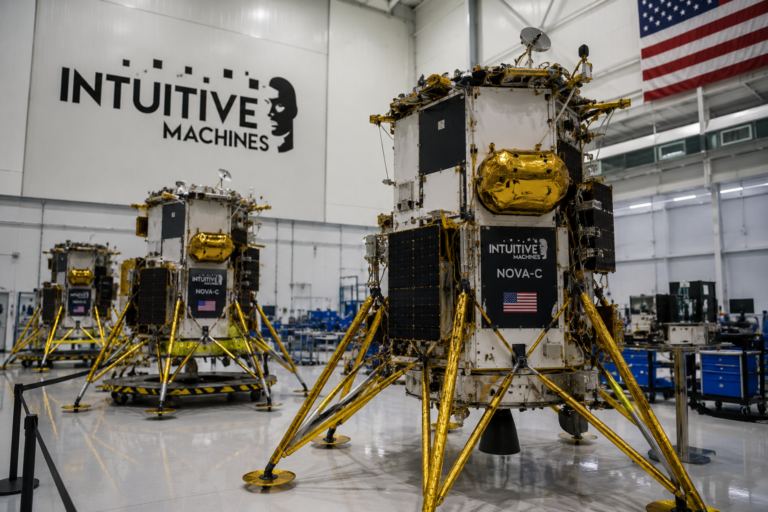
Intuitive Machines Inc. LUNR shares rallied sharply on Friday after multiple Wall Street analysts shifted their focus from the company’s second-quarter earnings miss to its rapidly expanding order backlog, arguing that the long-term growth outlook remains intact.

The stock climbed about 8.14% to $18.99 during Friday’s session after Stifel upgraded the lunar exploration company to Buy from Hold, despite lowering its price target to $26 from $32.

The move extended the stock’s recent momentum, with shares gaining in 11 of the past 12 trading sessions and up about 62% so far this month.

While Intuitive Machines reported second-quarter revenue and adjusted EBITDA below expectations, analysts said the company’s nearly $1.8 billion backlog has become the more important driver of the investment case.

Backlog growth becomes the key focus

Intuitive Machines ended the second quarter with a contracted backlog of nearly $1.8 billion, up roughly $707 million from the previous quarter.

Much of the increase came from a $600 million contract to build three commercial geostationary Earth orbit communications satellites.

Stifel analyst Jonathan Siegmann said the backlog expansion outweighed concerns surrounding quarterly financial results.

“It’s the backlog surge that is important,” Siegmann wrote.

The analyst added that the backlog is well diversified across civil, commercial and national security space programs.

Siegmann also argued that investors are paying too much attention to near-term execution while overlooking improving longer-term prospects.

“The 2027 outlook is substantially improving. Buy LUNR now while the market stays preoccupied with 2026. LUNR’s backlog build is diversifying and accelerating—this is the most important development of the quarter,” he wrote.

Analysts remain optimistic despite lower price targets

Other analysts also highlighted the company’s growing order book while making adjustments to their valuation targets.

Cantor Fitzgerald lowered its price target to $32 from $43 but maintained its Overweight rating.

Analyst Andres Sheppard pointed to the expanding backlog, along with contracts tied to NASA and the Golden Dome missile defense program, as reasons to remain constructive on the stock.

The firm also noted that Intuitive Machines reaffirmed its fiscal 2026 revenue guidance of $900 million to $1 billion and maintained expectations for positive adjusted EBITDA.

During the second quarter, the company secured its sixth lunar mission under NASA’s Commercial Lunar Payload Services program.

It also won the AMDT3 Golden Dome contract to design, build and deliver 18 spacecraft for the Space Development Agency.

Management disclosed that its third lunar mission is now expected to launch in the first quarter of 2027 instead of the fourth quarter of 2026, delaying recognition of roughly 10% of the related contract revenue.

Long-term contracts strengthen growth outlook

B. Riley also became more bullish following the earnings report.

Analyst Mike Crawford maintained a Buy rating and raised his price target to $45 from $43.

Crawford said the company’s $1.8 billion backlog “highlights growing momentum” as Intuitive Machines “aims to become the next-generation space prime.”

He added that Thursday’s trading reversal reflected investors shifting attention away from weaker-than-expected quarterly revenue toward the company’s expanding pipeline of future business.

Beyond recent awards, Intuitive Machines has also been selected under the US Space Force’s Andromeda multiple-award contract, which carries an initial value of up to $1.84 billion and a total potential value of up to $6.24 billion across participating companies.

Although analysts do not expect the company to reach profitability this year, its revenue has grown 117% over the past 12 months.

Wall Street now appears increasingly focused on whether its expanding contract portfolio can support sustained growth over the coming years.

The post Intuitive Machines stock jumps 8% as Wall Street backs $1.8B backlog appeared first on Invezz

US stocks ended lower on Friday as investors locked in profits following a record-setting rally, while weaker-than-expected retail sales data and renewed pressure on semiconductor shares weighed on sentiment.

The S&P 500 fell 0.2% to close at 7,785.76 after setting fresh record highs earlier in the week.

The Nasdaq Composite also declined 0.3% to 26,729.16, while the Dow Jones Industrial Average lost about 108 points, or 0.2%, to finish at 53,732.41.

Despite Friday’s pullback, the S&P 500 recorded its third consecutive weekly gain, rising 0.4% for the week.

The Nasdaq also posted a third straight weekly advance, while the Dow ended the week 0.6% lower.

Applied Materials leads semiconductor decline

Applied Materials weighed heavily on the broader market after investors reacted negatively to the company’s latest earnings outlook despite an upbeat quarterly forecast.

The chip equipment maker, whose shares have doubled so far in 2026 amid strong artificial intelligence-related demand, led declines across the semiconductor sector.

Other AI-linked chip stocks, including Broadcom and Intel, also moved lower as investors remained cautious about elevated valuations following a strong rally in technology shares.

The weakness in semiconductor stocks came despite robust corporate earnings.

According to LSEG, aggregate second-quarter earnings for S&P 500 companies have surged 52%, driven largely by technology giants such as Amazon and Microsoft.

With more than 90% of S&P 500 companies having reported quarterly results, earnings growth is tracking around 50% from the same period a year earlier, according to FactSet.

Meanwhile, Reddit surged after the social media platform was selected to join the S&P 500 index effective Aug. 18.

Shares of drone makers including Red Cat and Unusual Machines also gained after President Donald Trump announced tariffs on imported drones and drone components.

Weak retail sales add to economic concerns

Economic data released Friday pointed to softer consumer activity.

US retail sales unexpectedly declined in July after a 0.2% increase in June, while the University of Michigan’s preliminary consumer sentiment index fell to 51 in August, below economists’ expectations of 54.5.

The weaker economic data followed this week’s inflation reports, which largely matched expectations and reinforced market expectations that the Federal Reserve will leave interest rates unchanged at its September policy meeting.

According to CME FedWatch data, traders now see a 67% probability that the central bank will hold rates steady next month, with a 33% chance of another rate increase.

Energy stocks gain as oil prices rise

While technology shares struggled, energy stocks outperformed as crude oil prices advanced amid renewed geopolitical tensions in the Middle East.

Transit through the Strait of Hormuz remained severely disrupted after additional attacks on vessels, while the United States reiterated that it could maintain a naval blockade of Iran indefinitely.

Those developments supported higher oil prices and lifted the S&P 500 energy sector.

The broader market also continued to trade at elevated valuations despite Friday’s decline.

The S&P 500 is currently valued at roughly 20 times expected earnings, above the multiple at the end of July but below levels seen at the beginning of 2026.

Workday shares retreated after soaring in the previous session following reports that private equity firm Silver Lake is in discussions to acquire the software company.

The post Dow closes lower as Applied Materials leads semiconductor selloff appeared first on Invezz