Story Highlights The live price of the Stacks token is . Price predictions for 2026 range from $0.50 to $2.50. Long-term outlook suggests gradual growth potential to approach $20 by 2030. Stacks is the Bitcoin layer where Bitcoin holders come to grow their BTC through Bitcoin-native finance, and STX is what powers it: the gas …
The USD/JPY exchange rate wavered today, August 27, as traders waited for the upcoming Kevin Warsh statement at the Jackson Hole Symposium in Wyoming. It also wavered after the US published the latest PCE and GDP numbers. It was trading at 159.32, up by 2.68% from its lowest level this month.
Kevin Warsh statement at the Jackson Hole Symposium
The USD/JPY pair wavered after the US released the latest inflation and GDP numbers. A report showed that the personal consumption expenditure (PCE) rose 3.7% in the 12 months through July, unchanged from June. This figure was much higher than the average estimate of economics of 3.6%. The month-over-month figure of 0.2% was also higher than expected.
These numbers mean that inflation continues to remain above the 2% target, a situation that may continue as gasoline and diesel prices rises. The average gasoline price in the US is stuck above $4 a gallon, while diesel is slowly nearing the all-time high. This is happening even as Brent and West Texas Intermediate (WTI) benchmarks falls.
The next important USD news will come from the US, where Kevin Warsh, the Fed Chair, will talk at the Jackson Hole Symposium. His statement will be watched closely as traders look for clarity. In all his past statements, he has maintained a vague outlook on inflation and interest rates. Unlike Janet Yellen and Jerome Powell, he has avoided provided forward guidance.
As a result, the market is unsure of what to expect this year. According to Polymarket, the odds of a December rate hike stands at about 53%. In a statement, Robert Gill, a portfolio manager at Fairbank Investment said:
“This lack of direction can be frustrating. It is causing uncertainty and contributing to higher long-term bond yields, and this is an outcome that he seems to be designing.”
Top BoJ official hints at September hike
Meanwhile, the USD/JPY pair is reacting to a statement by Ryozo Himino, the BoJ Deputy Governor. In a statement, he said that the bank may consider hiking interest rates in the coming meeting next month. He said that this hike will be possible if inflation remains stubbornly high. He said:
“If underlying inflation deviates upward to a level above the price stability target of 2%, that would have an adverse impact on the economy.”
A BoJ rate hike would be bullish for the Japanese yen, which remains near its lowest level in decades. It would help to narrow the gap between the US and Japanese interest rates, reducing its appeal as a carry trade funding currency.
The next key catalyst for the USD/JPY pair will come from Japan, which will publish the latest Tokyo Consumer Price Index (CPI) report on Thursday. Economists expect the data to show that the Tokyo CPI rose 18% in August.
USD/JPY technical analysis
USDJPY chart | Source: TradingView
The four-hour chart shows that the USD/JPY pair has held steady in the past few days. Along the way, it has moved slightly above the 50-period Exponential Moving Average (EMA).
At the same time, the pair has formed an ascending triangle pattern, a common bullish continuation sign. Also, the two lines of the MACD indicator have moved above the zero line.
Therefore, the pair will likely have a bullish breakout as bulls target the year-to-date high of 163.97. This view will be confirmed if it moves above the crucial resistance level of 159.72.
Zoom Video stock suffered a big reversal this week, ending the recent bull run that pushed it to the highest level in months. It dropped by nearly 4% on Tuesday, and then by 5.7% in the premarket session. It reached a low of $95, down by nearly 15% from its highest point this year.
Zoom Communications published mixed financial results
Zoom, the popular video communications company, published a mixed earnings report, which showed that its business was still growing despite the rising competition from companies like Google, Microsoft, and Cisco.
The company’s revenue rose by 4.9% in the second June quarter to $1.27 billion, with its enterprise segment hitting $788 million. Its monthly churn remained at 2.9%.
However, the company’s gross and operating margin moved downwards during the quarter as it continued to spend more on AI. The gross margin dropped to 77.2%, while the operating margin moved downwards a bit to 24.6%.
A key bright spot for the company is its investments in AI tools, with Zoom Workplace with AI adding millions of users since its launch. It is also benefiting from Zoom Phone, a product that makes it easy for companies to communicate with clients and partners from around the world. According to its website, Zoom Phone has over 10 million active users. Eric Yuan, the CEO said:
“We are embedding AI across our platform to turn conversational context into action and deliver what customers want: real AI value that produces outcomes. “
Zoom Video stock dropped because its guidance was relatively softer than expected. The company expects that its Q3 revenue will be between $1.27 billion and $1.28 billion. According to Yahoo Finance, the average estimate is that its quarterly revenue will be $1.27 billion. Also, its forward EPS guidance of between $1.46 and $1.48 was lower than expected.
Still, on the positive side, Zoom is still trading at bargain, with its forward PE ratio being 17.3, much lower than the technology sector median. The stock, however, may remain under pressure until the company demonstrates stronger revenue and profitability growth.
In this case, it needs to constantly outperform the estimates. Yahoo Finance data shows that the average revene growth for the next two years is about 4%.
Zoom Video stock price technical analysis
ZM stock chart | Source: TradingView
The daily chart shows that the ZM stock has been in a strong upward trend since June 25 when it bottomed at $82.21. This rebound happened after it formed a double-bottom pattern whose neckline was at $94.37. A double-bottom is one of the most common bullish reversal sign in technical analysis.
Before the earnings report, the stock was forming a bullish pennant pattern, which is made up of a vertical line and a symmetrical triangle. As such, the crash has invalidated this pattern.
Therefore, the stock will likely remain under pressure in the near term. It may drop further to the psychological level of $90. In the long term, however, the stock may rebound and retest the resistance level of $110 once the post-earnings sell-off ends.
Meta Platforms (META) has reached a settlement to resolve claims from states that the company designed Instagram and Facebook to be addictive to children, misled consumers about the safety of its platforms, and improperly collected personal information from young users.
As part of the settlement, Meta agreed to pay $16.7 billion, with California expected to receive between $1.5 billion and $2.1 billion if the court gives final approval, according to California Attorney General Rob Bonta.
“Today, we have secured a settlement with Meta that will make social media less dangerous for our kids and make a world of a difference for children and their families,” Bonta said in a statement.
“Meta has agreed to make massive transformations that will reduce the risk of harm from its platforms — and will do it within months.”
The settlement was reached during a federal trial in California involving claims brought by 29 states, averting one of the most closely watched legal tests yet of allegations that social media companies have contributed to harm among young users.
The agreement was disclosed in a court filing on Wednesday outlining requirements Meta would have to implement under a proposed “consent judgement.”
Among the proposed changes are daily usage limits and “nighttime blocks” for teenagers using Facebook and Instagram.
Meta would also introduce “enhanced age assurance measures” designed to prevent children from accessing its apps and expand tools available to parents and guardians.
Meta shares rose more than 4% in premarket trading on Wednesday following news of the agreement.
However, the stock gave up most of those gains and was up by about 0.8% as the market opened.
States accused Meta of harming children
The federal trial covered claims brought by attorneys general in California, Colorado, Kentucky and New Jersey alleging that Meta violated state consumer protection laws.
The case also included claims from 29 states that Meta violated the federal Children’s Online Privacy Protection Act by collecting personal information from users it knew were children without parental notification or consent.
The states alleged that Meta also used children’s data to train machine learning and generative AI models.
The litigation forms part of a broader wave of lawsuits brought by states, local governments, school districts and individuals against Meta and other social media companies.
The cases allege that social media platforms contributed to a nationwide youth mental health crisis.
Meta has denied the allegations and maintained that it has taken significant steps to protect children on its services.
The company had also argued that it could not have misled consumers about whether its platforms were addictive because “social media addiction” is not a recognized psychiatric condition.
Before the trial, Meta said California, Colorado, Kentucky and New Jersey were seeking as much as $1.4 trillion in penalties.
The states had not specified a final figure but indicated at a pretrial hearing that the amount could be closer to $200 billion.
Settlement comes amid rising legal costs
The settlement arrives as Meta’s legal expenses have increased significantly, and investors are already watching the company’s spending closely.
Meta incurred $2.4 billion in legal fees during its latest quarter, contributing to an unusual decline in profit.
The company is simultaneously committing enormous amounts of capital to artificial intelligence infrastructure and development.
That spending has weighed on investor sentiment, with shareholders questioning whether Meta’s AI investments will generate sufficient returns and how much pressure they will place on near-term free cash flow.
Child safety litigation had therefore represented an additional risk for investors, particularly given the possibility of substantial financial penalties and costly changes to Meta’s platforms.
The settlement removes some of that uncertainty while potentially imposing significant operational changes on Facebook and Instagram.
Testimony preceded settlement
The agreement also came a day after Instagram chief Adam Mosseri testified in the trial.
Mosseri said he does not direct employees to withhold certain information about child safety and products from him in order to provide protection against potential litigation.
The settlement could now shift the focus from the courtroom to how Meta implements the proposed restrictions and whether the measures affect engagement among younger users.
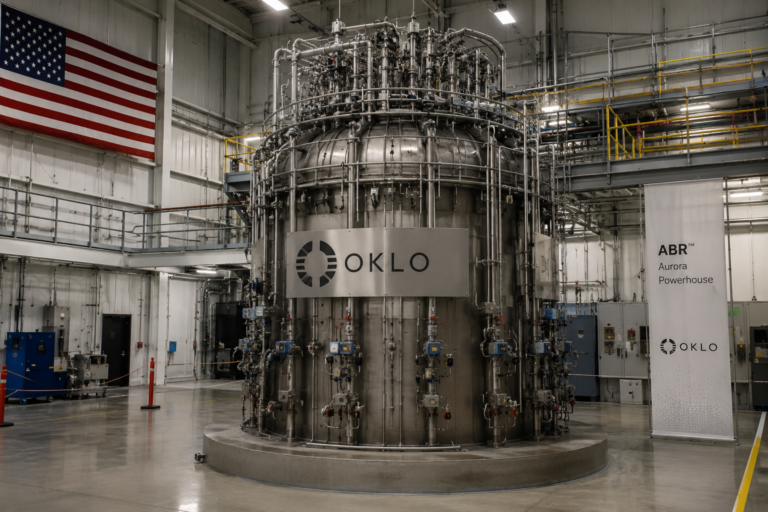
Oklo stock rose nearly 4% in premarket trading, extending the 12% gain from the previous session. The rebound came as investors returned to small modular reactor (SMR) stocks, including NuScale. However, Oklo still faces significant risks, which helps explain its elevated short interest and continued insider selling.
Top insiders have been selling Oklo stock
While Oklo stock has rebounded this week, it remains well below its all-time high of $194.26. The sharp sell-off has been highly profitable for short sellers, with the FT estimating that investors betting against companies in the industry have made more than $2 billion.
Top insiders have been selling their shares, which is usually a red flag. Barchart data shows that insiders have made 13 sales in the last three months, selling 641,806 shares in this period. At the current price, these shares would be worth over $22 million. They have made 53 sell orders of 4.3 million shares.
Some of the most aggressive sellers are insiders like Caroline Cochran, the COO, Jacob Dewitte, the Chair and COO. In most cases, insider sales is usually a red flag for a company.
Oklo faces some major risks ahead
Oklo, a company in the small modular reactor industry, faces some major risks and opportunities ahead. The main opportunity is the fact that demand for reliable power is rising, especially amid the ongoing artificial intelligence boom.
This demand is evident in the number of deals that Oklo has signed in the past. It signed a 12 GW deal with Switch, a data center operator. It also signed a deal with Meta, Equinix, Diamondback Energy, and Centrus Energy. These deals will help it monetize its technology in the coming years.
The risk, however, is that Oklo’s business is still unproven and the company is losing substantial sums of money. Its most recent results showed that its revenue was just $1.2 million, with its net loss rising to over $48 million. It made a net loss of over $24 million in the same period last year.
This risk explains why analysts have reduced their estimates recently. Citigroup’s Vikram Bagri slashed his target from $76 to $57, while Truist’s Christopher Souther, lowered it from $55 to $51. As a result, the average estimate of $85 is lower than $88, where it was last month. It also explains why its short interest has been rising, reaching 21% today.
Oklo share price technical analysis
Oklo chart | Source: TradingView
The daily chart shows that the Oklo stock bottomed at $36.60 on July 29 to the current $44.27. It has retested the important resistance level of $45.21, its lowest level on April 7 this year.
The stock has remained below the 50-day Exponential Moving Average (EMA), a sign that bears remain in control for now. It has also remained below the Supertrend and the Ichimoku cloud indicators.
Therefore, the stock will likely remain under pressure in the foreseeable future as dilution concerns remain. If this happens, it may drop further to the key support level of $20.
Scotiabank stock price continued its strong bull run this week, reaching an all-time high. BNS has jumped 30% this year and 68% over the past 12 months, outpacing the SPDR S&P Bank ETF (KBE), which has risen just 16% this year. This rally may continue in the foreseeable future, as the bank’s revenue growth is gaining momentum despite ongoing US-Canada trade tensions.
Scotiabank stock has jumped as revenue growth continues
Bank of Scotiabank is the fourth-largest Canadian bank by assets after Royal Bank of Canada, Toronto-Dominion Bank, and Bank of Montreal. Its financial results showed that its business is doing well, helped by its wealth management business.
The company’s net income jumped to C$2.9 billion in the third quarter from C$2.52 billion in the same period last year. Its profitability also continued rising, with its earnings per share rising to C$2.22. In a statement, Scott Thomson, the CEO, said:
“In particular, we exceeded our 14% return on equity target this quarter, highlighting the improvements that we have made across the bank to increase margins and fee income.”
The biggest driver for the its revenue was the its wealth management segment, which made C$518 million, up by 23% from the same period last year. Its banking and markets segment made $647 million, also 37% higher than what it made last year.
Bank of Nova Scotia’s Canadian banking and international segments made C$1.07 billion and C$766 million, respectively. These two segments rose by 12% and 8%, respectively.
The company continues to return funds to its investors, which has helped to boost its earnings-per-share. It repurchased 8.6 million shares in the last quarter, bringing its total repurchases and dividends to C$6.3 billion. It now has a dividend yield of about 3.5%, even as its stock remains at a record high.
A potential catalyst for the stock is that President Donald Trump will likely TACO on his ongoing trade war with Canada. Such a move will reduce the ongoing tensions between the two countries, which are some of the biggest trading partners in the world.
Still, there is a risk that Bank of Nova Scotia is relatively overvalued, with its forward price-to-earnings ratio of 15, higher than its American peers like Goldman Sachs and JPMorgan Chase.
Bank of Nova Scotia stock price analysis
BNS stock chart | Source: TradingView
The daily chart shows that the Scotiabank share price has been in a strong upward trend this year. It rose above the crucial resistance level of $127.58, its highest point in July and August this year. A move above that level invalidated the double-top pattern, which is a common bearish reversal sign.
The stock has remained steady above the 100-day Exponential Moving Average (EMA), while the Relative Strength Index (RSI) moved above the neutral level of 50. Therefore, the stock will likely continue the bullish momentum, potentially to the psychological level of C$150.
Even as Wall Street’s broader conviction on artificial intelligence holds firm, short-term positioning fatigue is threatening to unwind the market’s most lucrative trade.
Chip stocks face a sharp near-term drawdown risk, driven less by any operational stumble than by overcrowded portfolio bets colliding with macroeconomic pressure.
Bank of America semiconductor analyst Vivek Arya thinks the PHLX Semiconductor Index has another 10% of downside in it, a call he laid out for clients Monday.
A drop of that size would extend a two-month slide across the sector and pull valuation multiples back to levels last seen before ChatGPT’s 2022 launch.
BofA favours caution on chip stocks in the near-term
The projected pullback reflects a sector straining under heavy institutional weight as much as any deterioration in fundamentals.
Chip stocks sit 13% overweight relative to the S&P 500 – leaving the group exposed to forced selling the moment sentiment turns.
Beyond crowded positioning, Arya pointed to compounding pressures, elevated interest rates, emerging data-center backlash, and complex circular financing arrangements among AI infrastructure players that together could complete a valuation reset already underway.
Both indexes now trade near 20x forward earnings, a parity that erases years of valuation whiplash: chip multiples swung from a 9% discount to the S&P 500 before ChatGPT’s debut to a 15% premium at the height of the AI trade, before recent declines closed the gap.
Arya recommends buying chip stocks on further pullback
Despite flagging near-term downside, the Bank of America analyst recommends treating any further decline as an entry point rather than a warning sign.
Why? Because companies within the semiconductor index are expanding forward earnings per share (EPS) at a compound annual growth rate of roughly 70%.
Measured against that pace of growth, the analyst called the current 20x forward multiple “cheap,” adding that seasonal trading patterns have historically turned bullish heading into year-end.
On that basis, the firm assigned “enhanced buy” ratings to eight names: Nvidia (NVDA), Marvell, Micron, Lam Research, AMD, Intel, Analog Devices, and ON Semiconductor.
Catalysts are already in motion: Marvell is accelerating its custom AI chip rollout, while Nvidia reports quarterly results after Wednesday’s close, with BofA flagging risk from slowing capital-return plans and uneven enterprise demand.
What to look for moving forward?
The tension between crowded short-term positioning and durable secular earnings growth sets up a pivotal test heading into Nvidia’s report tonight.
A pullback tied to softer capital-return guidance could trigger further momentum selling in the immediate session, yet the return of chip valuations to historical parity has already wrung out much of the speculative excess.
From here, execution on custom silicon programs is likely to separate winners from laggards, with specialized suppliers such as Marvell positioned to gain share even as enterprise spending stays uneven.
Rather than signaling a structural break in AI capital expenditure, a further 10% reset would simply realign stock multiples with underlying earnings growth, clearing the runway for a rebound into year-end.