Archive

September 13, 2026

Browsing

The post Ripple & XRP News Roundup: Institutional Collateral, UK Expansion And More appeared first on Coinpedia Fintech News

Ripple’s footprint across institutional finance kept expanding this week, from XRP being adopted as collateral for institutional credit lines to a new seat at the table with the City of London’s tokenization initiative. Here’s everything worth knowing from the past seven days. XRP Emerges as Institutional Collateral XRP is increasingly being used as collateral for …

The post Grayscale’s Zach Pandl Declines To Pick Between Hyperliquid, Ethereum Or Solana appeared first on Coinpedia Fintech News

Asked which single asset he’d hold over the next five years, Hyperliquid, Ethereum or Solana, Grayscale’s Head of Research Zach Pandl declined to choose. “I don’t like to choose among my children like this,” he said, calling all three great projects. Pandl said he favors a diversified approach across crypto’s different market segments, currencies, smart …

SpaceX (SPCX) stock rose more than 1% on Friday to around $149 after initially slipping, extending its recovery from this week’s decline as investors digested another major artificial intelligence compute agreement.

The latest contract could add $1.11 billion in monthly revenue beginning December 1, according to CFO Bret Johnsen, who disclosed the agreement at Goldman Sachs’ Communacopia + Technology Conference.

That translates to roughly $13.3 billion in annualized revenue from a single undisclosed customer, giving investors another reason to reassess SpaceX’s valuation as an AI infrastructure company.

SpaceX lands another major AI customer

Johnsen said SpaceXAI closed the new compute-hosting agreement in early September.

William Blair reiterated its Outperform rating on SpaceX following the announcement, noting that the $13.3 billion annualized agreement is separate from the $6.7 billion, six-month compute deal SpaceX disclosed during its August earnings call.

The latest contract marks the fourth major compute agreement announced by SpaceX over the past four months with annualized value exceeding $11 billion.

In May, SpaceX announced a $1.25 billion-per-month agreement with Anthropic.

The company followed that with a deal with Google in early June worth $920 million per month.

The rapid expansion of these contracts is changing how investors may view SpaceX’s revenue potential.

The company generated about $23 billion in revenue over the last 12 months, according to William Blair, while its market capitalization stands at roughly $2.01 trillion.

SpaceX has also guided toward $100 billion in annual recurring revenue by the end of 2026.

Johnsen indicated at the Goldman Sachs conference that the company has increased conviction in achieving that target by December.

“Bret Johnsen, SpaceX’s chief financial officer, indicated that he has even more conviction now in achieving the $100 billion ARR target in December,” William Blair analyst Louie DiPalma said.

SpaceX is also significantly increasing its planned AI compute capacity.

The company now targets between 5 and 10 gigawatts by the end of 2027, compared with its previous goal of 2 gigawatts by the end of 2026.

DiPalma believes SpaceX has an advantage in deploying capacity faster than competitors, while its relationship with Nvidia provides SpaceXAI with priority access to GPUs.

“SpaceX has benefited from its ability to deploy capacity much faster than peers,” DiPalma said.

Lockups remain an overhang

The AI momentum comes after a volatile week for SpaceX stock.

Shares fell around 3% on Wednesday after the company’s third scheduled lockup tranche released up to 319 million Class A shares, worth roughly $49 billion at recent prices.

Another 59.1 million affiliate shares were unlocked on Thursday.

The additional supply initially pressured the stock, but shares recovered modestly on Thursday and are now up 12% over the past 30 days.

Investors are still facing billions of dollars of additional shares becoming eligible for trading, which could create intermittent selling pressure.

By the end of 2026, roughly 4.9 billion SpaceX shares are expected to have become available for trading.

Investors have been cautious about buying ahead of potential profit-taking by early shareholders.

The post Why SpaceX stock is up around 1% on Friday appeared first on Invezz

Investors are heading into next week’s Federal Reserve meeting with expectations of a rate hike at their strongest levels in months after August inflation data showed that price pressures remain stubbornly high.

The Consumer Price Index released Friday showed headline inflation rising 0.4% in August from July and 3.4% over the past year.

Both readings were in line with expectations.

The more closely watched core CPI measure, which strips out volatile food and energy prices, rose 0.3% during the month, faster than the 0.2% increase economists had expected.

Core inflation was 2.4% higher than a year earlier, easing from 2.5% in July and matching forecasts.

The monthly acceleration in underlying inflation, however, has strengthened the case for policymakers who have argued that the Fed should raise interest rates rather than wait for inflation to cool further.

The latest inflation data followed a robust August employment report that had already increased expectations for tighter monetary policy.

PPI data released on Thursday also increased the likelihood of a hike.

Traders in federal funds futures now see roughly an 85% to 90% probability of a quarter-percentage-point rate increase at next week’s meeting, according to the CME Group’s FedWatch gauge.

The central bank has held its policy rate in a range of 3.5% to 3.75% since January.

Core services add to inflation concern

One of the more worrying elements of Friday’s report for the Fed was the strength of services inflation.

The so-called “supercore” measure, which excludes energy and housing services, rose 0.5% in August and was up 3% from a year earlier.

While the Fed does not formally target this measure, some policymakers and investors watch it closely because it is intended to capture underlying price pressures that are less directly influenced by volatile goods or energy prices.

The August increase therefore provided another reason for markets to reassess the likelihood of a rate hike.

Jon Butcher, senior US economist at Aberdeen, said the increase in monthly core inflation could remove the main obstacle to a September move.

“A Federal Reserve hike next week is now looking highly likely. Today’s CPI data showed core prices re-accelerating in August, rising by an above consensus 0.3% month on month. This removed the main obstruction to a rise in the Fed funds’ rate next week, that price data had been showing a disinflationary trend,” he said.

The inflation data also come at a particularly sensitive time for policymakers, with energy prices adding another layer of uncertainty.

“We have seen a divided FOMC in the past weeks, with some members calling for hikes now, while others suggested that they would vote to remain on hold unless upside inflation risks materialised. As things stand today, the inflation data suggest those upside risks are manifesting. And with oil prices above $100 per barrel and no end to the conflict in the Middle East on the near-term horizon, inflation risks remain firmly tilted to the upside,” Butcher added.

Markets brace for a rate increase

Financial markets appeared to absorb the prospect of tighter monetary policy without a major selloff in equities.

US stocks moved higher after the CPI release, while Treasury yields were mostly steady.

The two-year Treasury yield, which is particularly sensitive to expectations for Fed policy, nevertheless touched its highest level since July 2024.

While the climb was a positive reaction to retreating oil prices, it nevertheless suggested investors were increasingly pricing in a rate hike without viewing it as an immediate threat to the broader economy.

The more important question may now be how far the Fed is prepared to go after an initial increase.

“The debate has quickly shifted from whether the Fed will hike to the more important question of how many hikes this cycle will ultimately require,” said Seema Shah, chief global strategist at Principal Asset Management.

“We do not expect the Fed to be one-and-done. This is no longer simply about fine-tuning the economy. After half a decade of above-target inflation, policymakers are likely to conclude that more than one hike will be needed to re-establish price stability.”

That would mark a significant change in the market narrative.

Investors had previously focused on the possibility that the Fed could keep rates unchanged if inflation continued to moderate.

August’s figures challenge that assumption.

Warsh faces a test of credibility

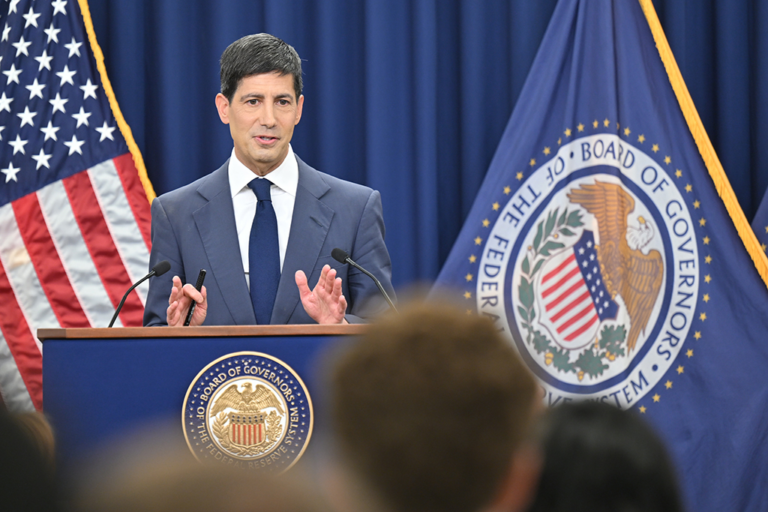
The policy decision is also shaping up to be a major test for new Fed Chair Kevin Warsh, whose approach to inflation has already attracted intense scrutiny.

Warsh has not committed publicly to a specific rate decision at the September 15-16 meeting.

But he has repeatedly indicated that the Fed would need to raise rates if inflation failed to moderate sufficiently.

At the Fed’s annual conference in Jackson Hole last month, Warsh sought to reinforce his commitment to bringing inflation back to the central bank’s 2% target.

“Here is my standard: We must be confident that underlying inflation is moving to our objective, clearly and at sufficient speed,” he said. “Otherwise, we have work to do.”

The statement was deliberately broad, leaving Warsh room to respond to incoming data.

The latest CPI report makes that flexibility more difficult to maintain.

Warsh’s challenge will not simply be deciding whether to raise rates.

He will also need to build consensus among policymakers and provide investors with a clear explanation for the decision.

At the Fed’s July meeting, the central bank kept rates unchanged, but Warsh’s explanation failed to fully clarify how he intended to deliver on his commitment to bring inflation back to target.

That contributed to uncertainty over the future path of policy.

A hike next week could therefore help establish a clearer policy direction.

Failure to act, meanwhile, could leave investors questioning how seriously the new chairman is prepared to respond to persistent inflation.

“Following the August PPI and CPI data and what will be not a disinflation friendly PCE for the Fed not to hike rates at its next meeting would be a blow to its own credibility given clear pricing dynamics following comments by Fed Chair Kevin Warsh at Jackson Hole and other rhetoric by both hawks and doves across the central bank in its aftermath,” said Joseph Brusuelas, Chief Economist at RSM US.

Fed remains divided over inflation outlook

There is already a group of policymakers arguing that interest rates are not sufficiently restrictive to bring inflation back to 2%.

Their argument is that higher rates would not only reduce demand but also prevent inflation expectations from becoming unanchored.

The opposing view has been that inflation would naturally moderate during the second half of the year, allowing the Fed to remain patient.

John C. Williams, president of the Federal Reserve Bank of New York and vice chair of the policy-setting committee, has argued that monetary policy is currently in a “good place”.

But Williams has also indicated that he would support higher rates if incoming data failed to show continued progress on inflation.

Christopher Waller, another Fed governor, similarly said he was inclined to keep rates unchanged next week if inflation continued to cool.

August’s figures have complicated that position.

Trump tensions raise the stakes

A rate hike would also carry political implications.

The decision comes only months before the election and could increase tensions between the Fed and President Donald Trump, who has repeatedly pushed for lower borrowing costs.

Last week, Trump threatened to halt a broad swath of US trade unless the Fed cut rates.

A rate increase would move in precisely the opposite direction.

For households, the timing is particularly difficult.

Consumers are already facing high prices, elevated borrowing costs and the potential for another wave of energy-related inflation as the Iran conflict pushes oil prices higher.

“Persistently high prices have weighed especially heavily on middle- and lower-income households, many of which are struggling to afford basic necessities,” said Mark Hamrick, an economic analyst and founder of The Hamrick Brief, in a previous CNBC report.

The Fed therefore faces a difficult balancing act: raising rates could put additional pressure on borrowers and households, while holding them steady could allow inflation to remain above target for longer.

Treasury and Fed goals diverge

The policy debate is further complicated by efforts from the Trump administration to reduce borrowing costs through the Treasury market.

Treasury Secretary Scott Bessent has spent recent weeks attempting to put downward pressure on long-term Treasury yields, including through Treasury buybacks.

The strategy has had limited success, with the 10-year Treasury yield trading just below 5%.

That creates an apparent tension between the Treasury’s desire for lower long-term borrowing costs and the Fed’s potential move toward higher short-term rates.

Bessent has rejected suggestions of a confrontation with Warsh.

“They want to set up Scott Bessent versus Kevin Warsh — that was rubbish,” Bessent said in an interview with Steve Bannon this week.

“Kevin and I have known each other for 20 years. To think that I don’t know what the chair of the Fed’s thinking is is absurd.”

Still, the contrast in policy objectives is difficult to ignore.

The Treasury wants to contain financing costs, while the Fed’s primary responsibility is to restore price stability.

The post Hike or hold? Fed policy meet next week to test Kevin Warsh's credibility appeared first on Invezz

The crypto market remained on edge during the weekend as investors reacted to the elevated crude oil prices and the upcoming Federal Reserve interest rate decision. Bitcoin and Ethereum to $77,000 and $2,500, respectively, while the Crypto Fear and Greed Index has moved to 68. This article provides a forecast for some of the top tokens like Pi Network (PI), Pepe Coin (PEPE), and Zcash (ZEC).

Pi Network price prediction

Pi Coin price has moved upwards in the past few days. It has jumped from a low of $0.0715 in July to the current $0.097 as focus remains on the upcoming V27 upgrade. This upgrade will improve its smart contracts features.

Technicals suggest that the coin may be on the cusp of a bearish breakout, potentially to theall-time high. For one, it has formed a rising wedge chart pattern. This pattern is made up of two ascending and converging trendlines. 

In most cases, a bearish breakout normally happens when the two lines are about to converge. At the same time, the token remains below the 100-day Exponential Moving Average (EMA), while the Relative Strength Index (RSI) has formed a bearish divergence pattern. 

Therefore, the most likely scenario is that the coin forms a bearish breakout, potentially to the year-to-date low of $0.07156. The bearish outlook will become invalidated if it moves above the key resistance level of $0.1110. 

Pi Network price chart | Source: TradingView

Pepe Coin price forecast

Pepe Coin price has done well in the past few months, moving from a low of $0.0000022 in July to a high of $0.000004547 on August 22nd. This rebound coincided with the broader crypto market rally that pushed Bitcoin and Ethereum to the highest levels in months. 

Most recently, however, the coin has pulled back to the current $0.000003478. It has formed a falling wedge pattern, which is made up of two descending and converging trendlines. This pattern often leads to a strong bullish breakout. 

Pepe price chart | Source: TradingView

The falling wedge is part of the bullish pennant pattern, which is made up of a vertical line and a triangle. Therefore, the most likely scenario is where it breaks out higher, potentially to the key resistance level of $0.0000040. The bullish outlook will become invalidated if the coin drops below the lower side of the wedge.

Zcash price prediction

ZEC price chart | Source: TradingView

Zcash price has done well in the past few months. It jumped from the year-to-date low of $188 in January to a record high of $1,288. This surge happened as demand for privacy tokens continued rising. Also, it happened as demand for the recently launched Grayscale Zcash ETF (ZCSH) jumped. 

The coin has already crossed the important resistance level of $747, its highest level in November last year. Breaking that level was important because it confirmed the bullish outlook. 

The coin has now remained above the 50-day and 100-day moving averages. At the same time, the Relative Strength Index (RSI) has moved from the overbought level of 87 to the current 64. The RSI has formed a double-top pattern. Therefore, the token will likely continue falling, potentially to the support level of $1,000. A move above the year-to-date high of $1,288 will invalidate the bearish outlook.

The post Top crypto price predictions today: Pi Network, Pepe Coin, Zcash appeared first on Invezz

WTI crude oil prices drifted lower on Friday, even as the energy market experienced a major development that could squeeze the already thinned supply. The West Texas Intermediate (WTI) dropped to $99.98 from this month’s high of $104.5, while Brent fell to $104.3. 

Crude oil prices face major risks ahead

There are reasons to believe crude oil prices will continue rising in the near future. Saudi Arabia has shut its East-West pipeline, which normally handles several million barrels of oil per day, meaning that supply will be reduced in the near term. Making matters worse, it could take weeks or months for the pipeline to reopen given ongoing attacks in the region.

Second, traffic through the Strait of Hormuz remains significantly lower than where it was a few months ago. Just a handful of ships are passing through these days as insurance costs have risen. Many insurance companies are afraid that the ships will be hit by Iranian missiles and drones. Indeed, the UKMTO reported that a ship attempting to cross was hit by an unknown projectile. 

Further, Ansar Allah, commonly known as Houthis, have taken control of a major port in Yemen. This means that it will be difficult for Saudi Arabia to ship its oil in the near term, even when the East-West pipeline is fixed. 

Most importantly, there are no signs that the US-Iran war will end any time soon. Trump has insisted that the war will end as soon as the midterm elections end in November. The election is nearly two months away, meaning that the supply squeeze will remain. 

Also, there is a likelihood that Iran will seek to escalate the situation. Some analysts warn that it will have an “October Surprise,” possibly an attempt to sink a US destroyer or an aircraft carrier. Such a move would lead to a supply squeeze, pushing oil prices higher. 

At the same time, there is a likelihood that China will restart its large-scale oil purchases, which will lead to higher oil demand. All this is happening at a time when oil inventories in key countries like the United States and China have remained at a low level. 

The next key catalyst for oil prices will be a meeting between Iranian officials and GCC countries like Saudi Arabia, Bahrain, and Qatar. The meeting’s goal is to reopen the Strait of Hormuz.

WTI crude oil price technical analysis

WTI oil price chart | Source: TradingView

The daily chart shows that the WTI crude oil price has rebounded in the past few months, moving from a low of $67 in July to a high of $104 last week. It has moved above the upper side of the symmetrical triangle pattern. 

Oil has jumped above the important resistance level of $93.23, its highest swing on July 23rd this year. It has also jumped above the 50-day Exponential Moving Average (EMA), a sign that bulls remain in control for now.

The Relative Strength Index (RSI) has continued rising, moving from a low of 29 in July to the current 68. Therefore, the most likely oil price forecast is bullish, with the next key target to watch being at $117.75. This price target is about 80% above the current level.

The post WTI crude oil price forecast as Middle East risks remain elevated: can it hit $120? appeared first on Invezz

Top companies in the private credit industry have pulled back over the past few days as investors reassessed their outlook on the Federal Reserve. Most have fallen into correction territory, dropping more than 10% from their recent highs. This article examines how the Fed’s next move could affect these stocks.

Private credit stocks have pulled back this month

The biggest companies in the private credit industry are struggling, with their recent attempts to rebound facing substantial resistance. Blue Owl Capital (OWL) ended last week at $10.56 and has dropped by 56% from its highest level in January last year. This retreat has seen its market capitalization fall from $40 billion to $16.4 billion. 

KKR, the private equity pioneer that has also become a big name in the private credit sector, ended at $101, down by 13% from its highest level in August. Other companies like Apollo Global Management, Blackstone, and Ares have also dropped. 

Notably, the VanEck BDC Income ETF (BIZD) dropped to $13, down by over 4% from its highest point in August this year. This fund tracks the biggest business development companies in the US, including Ares Capital, Main Street Capital, Hercules Capital, Golub Capital, and Sixth Street Specialty Lending. 

Federal Reserve expected to hike interest rates

The main reason why these private credit stocks have retreated is that investors now expect that the Federal Reserve will hike interest rates in the upcoming meeting. Odds of this hike happening rose to over 80% on Polymarket and Kalshi. The same is happening on CME, where the FedWatch tool has jumped to 85%.

These odds jumped after the US released the recent macro numbers. For example, the report showed that the economy created 162k jobs last month, while the unemployment rate remained unchanged at 4.1%. 

Another data showed that inflation remained at an elevated level last month. The headline consumer inflation remained at 3.4%, while the core figure rose slightly on a month-on-month basis. 

Fed hikes and rising energy prices may hit private credit companies

In theory, the Fed rate hikes should be bullish for companies in the private credit industry. That’s because these companies offer their loans on a floating rate, which is based on the Secured Overnight Financing Rate (SOFR). 

In this, the interest rate they charge is usually calculated as SOFR plus a spread. As such, as interest rates rise, the profits they make are usually higher.

The challenge, however, is that higher interest rates, especially for a long time, normally affects the portfolio companies. Also, this is happening at a time when crude oil prices are in a strong upward trend. Gasoline jumped to $4.31, while diesel has jumped to a record high of over $6.1. 

Therefore, there is a risk that the higher rates and oil prices will lead to higher default rates in the coming months. This is happening at a time when many investors are redeeming their capital from private credit funds, including those run by companies like Blue Owl, Apollo, and Morgan Stanley.

The post How will private credit and equity stocks react to Fed rate hikes? appeared first on Invezz