
Archive

July 23, 2026

Browsing

The Japanese yen remained under intense pressure today, July 23, as traders rushed to the US dollar amid the rising tensions in the Middle East. The USD/JPY pair was trading at 163.07, a few pips below this week’s high of 163.2. 

Japanese yen crash is continuing

The Japanese yen has continued falling this month, even as the country’s central bank has launched several defensive measures. 

The Bank of Japan has hiked interest rates to the highest level since 1995, and hinted that it may deliver more increases. 

At the same time, the bank has spent more than $73 billion on foreign exchange market interventions. While these interventions typically trigger a stronger yen, the gains have historically been short-lived.

The Japanese yen has mostly dropped because of the significant gap that exists between the US and Japanese interest rates.

Japanese rates have jumped to 1%, while in the United States, the Fed has left them unchanged between 3.50% and 3.75%.

Economists and traders now expect the Fed to hike rates further this year as inflation concerns remain. Odds of a Fed hike have jumped to over 67% on Polymarket.

Higher interest rates in the United States have made the US dollar more attractive than the Japanese yen.

They have also fueled the popularity of the USD/JPY pair among carry traders, who borrow in low-interest-rate currencies to invest in higher-yielding ones.

The ongoing crisis in the Middle East has contributed to the ongoing Japanese yen sell-off because the country depends substantially on oil coming from the region. In a statement, an Iranian official said that the crisis would escalate. He said:

“If the Americans target a bridge or a power plant in Iran, Iran will, in turn, strike infrastructure and bridges in the region, including energy facilities where the United States has interests.”

Data shows that Brent and the West Texas Intermediate (WTI) continued rising overnight as the crisis continued.

Also, Houthis hit an oil tanker attempting to cross the Bab El-Mandab Strait. Brent jumped to $96, while the West Texas Intermediate (WTI) approached the key resistance at $90. These events have fueled the US dollar gains as investors rush to its safety.

USD/JPY technical analysis

USD/JPY chart | Source: TradingView

The daily chart shows that the USD/JPY pair has continued rising in the past few months. These gains have been supported by the 50-day Exponential Moving Average (EMA). 

The pair has recently crossed the important resistance level of 162.82, its highest level on July 1. It also remains above the Supertrend indicator. 

Therefore, the path of the least resistance for the pair is bullish, with the next key level to watch being at 164. A move above that price may see it hit the resistance at 165 over time.

The post USD/JPY forecast: what next for the falling Japanese yen? appeared first on Invezz

Forex markets became cautious on Thursday as oil prices continued to rise due to growing tensions in the Middle East.

Investors are also focused on key central bank and economic events later in the day.

The European Central Bank is scheduled to announce its monetary policy decisions in the second half of the day.

The latest developments in the Middle East have added to concerns across financial markets.

US Stock futures fall as risk aversion builds

US stock index futures were trading lower, with losses ranging between 0.6% and 0.8%.

The declines came as investors assessed the latest geopolitical developments and their potential impact on financial markets.

The US Dollar (USD) Index, meanwhile, remained relatively stable.

The index was holding slightly above the 101.00 level at the time of press.

Euro holds above 1.1400 ahead of ECB decision

The euro remained relatively stable against the US dollar during early European trading on Thursday.

After posting marginal gains on Wednesday, EUR/USD held above 1.1400.

The pair was trading with limited movement as markets awaited the ECB’s monetary policy decision later in the day.

The ECB decision is expected to remain a key focus for currency markets.

Investors will be watching the central bank’s policy announcement as they assess the direction of the euro.

Pound struggles to build recovery momentum

GBP/USD also remained under pressure during Thursday’s European session.

The pair found a foothold and closed flat on Wednesday.

This came after it recorded significant losses for four consecutive days.

However, the pound struggled to build further recovery momentum on Thursday.

GBP/USD moved sideways below the 1.3400 level during the European session.

The pair’s movement reflected continued caution in the currency market.

Investors remained focused on broader market developments as risk sentiment weakened.

Yen weakens as USD/JPY climbs above 163.30

USD/JPY also remained in focus during Thursday’s session.

The pair’s correction proved short-lived on Wednesday.

USD/JPY recovered and ended the day virtually unchanged above 163.00.

The pair then gained traction during the European session on Thursday.

It traded at its highest level in about four decades, moving above 163.30.

Japanese Finance Minister Satsuki Katayama reiterated early Thursday that his government is “ready to take decisive action on foreign exchange as needed.”

The comments came as the Japanese yen remained under pressure against the US dollar.

The rise in USD/JPY kept attention on potential foreign-exchange market action by Japanese authorities.

Indian rupee edges higher against US dollar

The Indian Rupee (INR) opened marginally higher against the US Dollar (USD) on Thursday.

The move came amid possible intervention by the Reserve Bank of India (RBI) in the spot and non-deliverable forwards (NDFs) markets to support the currency.

The USD/INR pair edged lower to near 96.47 during the session.

However, the pair remained close to its two-month high of 96.75, which was recorded on Monday.

The rupee’s movement came as currency markets remained sensitive to developments in the US dollar and broader risk sentiment.

The possibility of RBI intervention also remained a factor in the pair’s trading activity.

Overall, financial markets remained cautious on Thursday as rising crude oil prices and escalating Middle East tensions weighed on risk appetite.

At the same time, investors awaited the ECB’s monetary policy decision and US Initial Jobless Claims data for further direction.

The post Forex markets turn cautious as oil surges on Middle East risks appeared first on Invezz
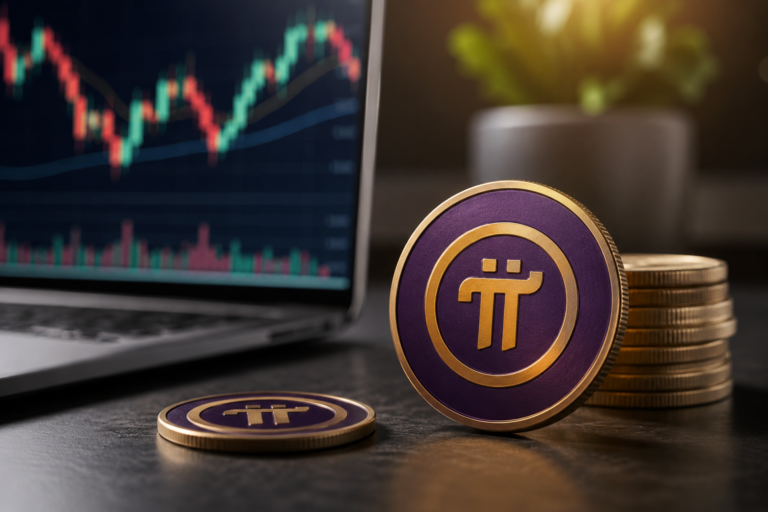
Pi Network has staged a notable recovery after falling to a fresh all-time low earlier this month, but the next phase of its price action may prove far more difficult.

At the time of writing, PI is trading at $0.09119, down 1.9% over the past 24 hours but still 10.7% higher over the last seven days.

The launch of Protocol v25 has given the Pi Network community a fresh catalyst, helping PI rebound from its recent lows.

Even so, persistent token unlocks, strong resistance at $0.10, and renewed security concerns continue to shape the outlook for the cryptocurrency.

Protocol v25 strengthens the network, but price still faces resistance

The release of Protocol v25 marks one of Pi Network’s most important technical upgrades in recent months.

The update introduces improvements designed to enhance network stability, strengthen privacy, and improve the platform’s readiness for developers building decentralised applications.

Among the most significant additions are support for BN254 cryptography and Poseidon hashing, two technologies commonly associated with privacy-preserving applications and zero-knowledge proof systems.

The update also includes improvements aimed at making the ecosystem more efficient as the network continues to mature.

https://twitter.com/openmainnet/status/2079715282600513887?s=20

While the upgrade has generated renewed optimism within the Pi community, the market has yet to deliver a decisive bullish confirmation.

PI recently recovered nearly 30% from its all-time low of $0.07059, recorded on July 14, 2026.

However, the rebound has slowed as the token approaches the psychologically important $0.10 level.

That price has become a key technical barrier. Previous recovery attempts have struggled to establish sustained trading above it, making it an important level to watch in the coming sessions.

A successful move beyond $0.10 could expose the next resistance around $0.12, while additional resistance sits near $0.135 and $0.15.

Token unlocks remain a major challenge

Although Protocol v25 has improved the project’s technical foundation, supply dynamics remain one of the biggest obstacles to a stronger recovery.

Over the next 30 days, approximately 127.5 million PI tokens are scheduled to be unlocked, averaging about 4.25 million PI per day.

Every unlock increases the amount of PI that holders can sell, creating additional pressure on the market.

For buyers to absorb that additional supply, demand needs to remain consistently strong. Otherwise, each wave of newly unlocked tokens has the potential to slow or reverse upward price momentum.

This supply overhang helps explain why many traders remain cautious despite the recent rebound from the July lows.

Technical indicators show improving momentum

Several technical indicators suggest that bearish pressure has eased compared with earlier this month, although they do not yet point to a confirmed breakout.

The Relative Strength Index (RSI) has moved back toward neutral territory after previously approaching oversold conditions.

That indicates selling pressure has moderated, but it does not yet signal a strong bullish trend.

The Moving Average Convergence Divergence (MACD), however, continues to reflect lingering bearish momentum, suggesting that buyers still need stronger follow-through before sentiment can shift decisively.

Other indicators paint a more constructive picture.

The Aroon Up indicator has strengthened while Aroon Down has weakened, a sign that buyers have regained some control after the recent decline.

Meanwhile, while the Supertrend indicator is yet to turn bullish, the Chaikin Money Flow (CMF) has moved into positive territory, pointing to improving capital inflows.

The Average Directional Index (ADX) also remains elevated, indicating that the current market trend is relatively strong, even if its long-term direction has yet to be fully established.

Taken together, these indicators suggest momentum has improved, but the market still needs confirmation through a sustained move above resistance.

Security concerns add another layer of uncertainty

Away from price action, Pi Network users are also paying close attention to wallet security after reports emerged from the community involving missing balances following token migration.

One Pioneer claimed that after a three-year lockup period ended, an attempted migration of 143 PI resulted in a wallet showing a zero balance alongside multiple failed transactions.

https://twitter.com/RizoWeb3/status/2078724108603515329?s=20

The report has not been confirmed as a network-wide issue, and there is currently no public evidence linking the incident to a flaw in the protocol itself.

The case nevertheless renewed calls within the community for stronger wallet protection, including mandatory two-factor authentication.

Pi Network has repeatedly warned users to remain cautious of phishing attempts, unofficial wallet tools, and anyone requesting recovery phrases or private keys.

As interest in PI increases following Protocol v25, scammers may also become more active, making wallet security an important issue for users.

The post Pi Network price forecast: Will Protocol v25 boost overcome token unlock pressure? appeared first on Invezz

HyroTrader, a crypto prop firm headquartered in Prague, has been named Best Prop Trading Firm at the CoinGape Web3 Innovation Awards 2026.

The recognition rewards the company’s exchange-connected funding model for digital asset traders and arrives as demand for funded trading accounts continues to climb across the crypto industry.

The CoinGape Web3 Innovation Awards honor organizations, products, and innovators shaping the future of Web3 across multiple categories.

Winners are decided by an independent judging panel featuring representatives from Polygon Labs, Visa, Beldex, Shirplink, and Liminal Custody.

HyroTrader was selected in the prop trading category on the strength of its direct exchange execution model, its risk management framework, and its consistent payout record.

Why crypto prop firms are drawing more traders

A crypto prop firm provides traders with access to the company’s capital once they pass a structured evaluation, usually called a challenge.

Instead of risking personal savings, a trader pays a one-time fee, proves they can hit a profit target while respecting drawdown limits, and then trades a funded account while keeping the majority of the profits.

For skilled traders, the model converts a large capital requirement into a small, defined cost.

That promise has pulled thousands of traders into funded trading, but it has also exposed the differences between operators.

Dozens of prop trading firms have disappeared in recent years, often after payout delays or sudden rule changes, and traders have responded by scrutinizing two things above all: how a firm executes trades and whether its payout claims can be independently confirmed.

Execution quality and verifiability, rather than headline profit splits, now separate the leading crypto prop trading operators from the rest.

Inside HyroTrader’s exchange-connected funding model

Execution is where the Prague company has staked its reputation.

Unlike providers that run evaluations on internal pricing systems, the HyroTrader prop firm routes trading activity to real exchange environments through a secure API connection to Bybit, an approach it pioneered in 2023 with the industry’s first direct exchange integration.

Funded traders operate on their own exchange accounts across more than 700 USDT perpetual pairs, filling orders in live order books rather than simulated feeds.

Traders who prefer a terminal can use the same model through Tealstreet or the CLEO app.

The rulebook is built for crypto’s 24/7 rhythm. The one-step evaluation carries a 10 percent profit target with a 4 percent daily drawdown and a 6 percent maximum loss, a minimum of five trading days, no time limit, and no stop-loss obligation.

Challenges start at $59, a $100,000 account costs $579, and the fee is refunded in full with the first payout. Profit splits start at 80 percent and scale to 90 percent without paid upgrades.

HyroTrader at a glance:

  • Founded in 2022, headquartered in Prague, Czech Republic
  • Funded accounts up to $200,000, with a scaling path to $1,000,000 for consistently profitable traders
  • More than 700 USDT perpetual pairs traded via Bybit API, Tealstreet, or CLEO
  • Profit split of 80 percent, scaling to 90 percent
  • On-demand payouts processed within 12 to 24 hours in USDT or USDC, verifiable on-chain
  • Over 1,700 funded traders, more than $5 million paid out, and a community of 35,000+ members

“This award reflects the standard we set for ourselves from day one: real exchange execution, clear rules, and payouts traders can verify,” said Samuel Drnda, CEO of HyroTrader.

“Recognition from a panel of this caliber confirms that transparency is not a marketing angle. It is the future of prop trading.”

Hyro Protocol brings prop trading on-chain

The award arrives as HyroTrader prepares a broader push toward verifiable trading infrastructure.

On July 8, the firm announced Hyro Protocol, an on-chain crypto prop trading protocol built on Solana that settles in USDC.

Hyro Protocol is designed to connect traders seeking capital with liquidity providers seeking exposure to verified trading strategies.

At its core sits a vault model: structured capital pools governed by smart-contract-enforced rules, with transparent accounting and on-chain performance records.

Traders can prove themselves through Challenge Vaults or, with an established track record, apply to manage liquidity provider capital directly through Direct Vaults.

Key protocol events, including vault creation, deposits, NAV updates, and payouts, are designed to be verifiable on-chain.

“Most prop firms still run on closed systems where rules can change mid-evaluation and payouts happen behind closed doors,” Drnda added.

“Hyro Protocol replaces trust with verification. Traders own their track records, LPs can check every number on a block explorer, and capital scales with performance instead of one company’s balance sheet.”

Trade execution will remain on professional exchange infrastructure while protocol state settles on-chain, a structure intended to preserve the liquidity and execution quality traders expect.

The company says it will publish program IDs, audit reports, and explorer links as each protocol component goes live.

What the award signals for funded trading

For the funded trading sector, the recognition of an exchange-connected, verification-focused operator points to where the category is heading.

As traders grow more selective, crypto prop firms able to prove their execution and payment records, rather than simply advertise them, are increasingly the ones setting the standard.

Funded trading involves evaluation fees and market risk, and nothing in this article constitutes investment advice.

The post HyroTrader named Best Crypto Prop Firm at Web3 Awards appeared first on Invezz

Oklo Inc. (OKLO) shares moved higher on Wednesday after a report said the advanced nuclear reactor developer is joining a Trump administration-led initiative designed to accelerate the development of new power plants to support the rapid expansion of artificial intelligence data centers.

According to a Bloomberg report citing a document it reviewed, Oklo and X-Energy will participate in a $200 million government program aimed at speeding up the deployment of power infrastructure needed to meet growing AI-related electricity demand.

The initiative also includes technology companies Microsoft and Nvidia and could be formally announced at an AI energy summit convened by the US Department of Energy.

Oklo shares rose as much as 5.9%, while X-Energy gained as much as 3.2% on Wednesday.

AI data center growth drives nuclear power push

The reported initiative comes as policymakers and technology companies seek solutions to rising electricity demand created by the rapid expansion of AI data centers.

According to Bloomberg, the program is intended to address concerns that the buildout of AI infrastructure has contributed to higher electricity prices across the United States.

Technology companies including Nvidia and OpenAI have previously identified energy availability as one of the biggest challenges to expanding AI adoption while maintaining the United States’ competitive position against China in artificial intelligence.

The Department of Energy is expected to use the initiative to accelerate the development of next-generation nuclear facilities capable of providing continuous, carbon-free electricity for large-scale AI computing infrastructure.

Bloomberg reported that several Department of Energy national laboratories, along with institutions including the University of Texas at Austin, are expected to share $60 million over a three-year period under the initiative.

Program targets faster nuclear plant development

According to the document reviewed by Bloomberg, one of the primary objectives of the initiative is to reduce the time required to design, license and construct new nuclear power plants.

The program also seeks to lower the staffing requirements needed to operate future facilities.

The Department of Energy estimates that approximately 300 gigawatts of new nuclear generating capacity will be required by 2050 to meet future electricity demand.

However, advanced nuclear reactors have not yet begun operating on a commercial scale.

Alongside this initiative, the Department of Energy has pursued other measures to support nuclear development, including plans to provide plutonium from Cold War-era nuclear weapons for use by commercial reactor developers.

AI investment reshapes US energy priorities

The latest effort reflects increasing attention from the US administration on ensuring sufficient energy infrastructure to support continued AI development.

Demand for electricity has accelerated after years of relatively flat growth, driven largely by the expansion of AI data centers requiring significant computing power.

The increasing strain on power markets and its effect on consumer electricity prices have also emerged as political issues ahead of the November midterm elections.

The reported initiative highlights the growing intersection between artificial intelligence, energy policy and advanced nuclear technology as governments and technology companies work to secure reliable sources of power for the next phase of AI infrastructure expansion.

The post Oklo stock jumps as firm joins $200M US AI nuclear power initiative appeared first on Invezz

Rocket Lab’s stock price jumped more than 3%  after the company secured a major contract from the U.S. government. RKLB climbed to $72.15, about 12% above its lowest level this month. The key question now is whether this rebound marks the start of a sustained rally or is simply another dead-cat bounce.

Rocket Lab wins a big US government order

RKLB stock jumped after the SpaceX competitor won a $266 million contract by the Department of War. This contract is for its suborbital launch services of 12 vehicles with six optional ones.

The order will be implemented at its the Pacific Spaceport Complex in Alaska and will be completed by December 2028

Rocket Lab has emerged as one of the fastest-growing companies in the space industry. In its last financial results, the company said that its revenue jumped by 63% to $200 million as its revenue backlog soared by 20% to $2.2 billion.

The company is benefiting from its Electron orders, which have continued rising in the past few months. It is also positioning in the hypersonic space, with its Hypersonic Accelerator Suborbital Test Electron (HASTE). This product will likely continue doing well as the US government continues to invest in hypersonic technology.

It is also seeing more orders of the Neutron platform, which is its medium-lift, reusable orbital rocket that will compete with SpaceX Falcon 9. It will be much bigger than Electron and will be reusable. It signed five new Neutron launches in the first quarter. 

Rocket Lab’s business is booming such that it received more orders in the first quarter of the year than it did in the whole of last year.

RKLB to publish its earnings soon

The next key catalyst for the RKLB stock will be released early next month. These earnings are expected to show that its business did well in the last quarter as its revenue soared. 

The average estimate is that its revenue rose by 59% to $230 million in the second quarter. For the year, analysts expect the revenue to come in at $918 million, up by 52% YoY. 

In addition to the organic growth, the company is also focusing on acquisitions. It acquired Mynaric, which provides laser optical communications, Motiv Space Systems, and most recently, it bought Iridium, its biggest buyout on record.

Analysts have a bullish outlook for the RKLB stock. The average estimate is that its stock will jump to $110, much higher than the current $71. Some of the most bullish analysts are from companies like Citizens, Craig Hallum, and Roth Capital.

READ MORE: Rocket Lab stock analysis: megaphone forms as experts remain optimistic

Rocket Lab stock price technical analysis

RKLB stock chart | Source: TradingView

The weekly chart shows that the RKLB stock has pulled back sharply in the past few weeks. It dropped from a high of $151 in May to the current $71. It remains above the 100-week Exponential Moving Average (EMA). 

The stock remains above the ascending trendline that connects the lowest swings in April, November, and July. It has always rebounded after hitting this support level.

It is also in the process of forming a harami candlestick pattern. Therefore, the stock will likely bounce back in the near term. If this happens, the next key level to watch will be the psychological level of $100.

The post Rocket Lab stock analysis: why it’s rising and what comes next appeared first on Invezz